

Effective Stretches and Movements for Prolonged Sitting All Day Long
If you spend a significant part of your day in front of a computer, you’re likely familiar with how your body starts to show signs of fatigue over time: neck tension, back discomfort, and stiffness in your legs when you finally stand up. It’s no surprise—sitting for extended periods is one of the most defining features of contemporary lifestyle, especially in a world where remote and hybrid work has become a reality for millions.
The good news is that small breaks with simple movements and stretches can be valuable allies in your daily routine. It’s not about replacing regular physical exercise, but about taking care of your body during the hours it needs attention—before fatigue accumulates too much. This article provides general and evidence-based guidelines to help you understand why movement matters and how to start in an accessible and safe way.
It’s important to remember: the information here is educational and general. Each body has its own peculiarities, health history, and unique needs. Therefore, throughout the text, you’ll find guidance on when it might be worth seeking a qualified professional for an individualized assessment.
Why Prolonged Sitting Concerns Specialists
Prolonged sitting posture is a growing subject of study in public health. Organizations like the World Health Organization (WHO) include sedentary behavior among the risk factors for a range of health conditions—regardless of whether the person exercises at other times of the day.
When we sit for hours on end, some physiological processes slow down: circulation in the legs may be reduced, postural muscles work in a static and prolonged manner (often causing tension and discomfort), and joint mobility tends to decrease over time. Peer-reviewed studies suggest that interrupting sitting time with small active breaks throughout the day can contribute to overall well-being—though it’s important to be clear that there is no single or “miraculous” solution for the effects of a sedentary lifestyle.
The goal here is not to create anxiety but to offer perspective: moving throughout the day, even briefly, often makes a difference in how your body and mind feel.
The Signals Your Body Sends—and What They Might Indicate
Before talking about stretches, it’s worth recognizing the warnings your body usually gives when it needs movement:
- Tension and stiffness in the neck and shoulders, often associated with prolonged forward head position
- Lower back pain or discomfort, which may be related to lack of support or the posture adopted for hours
- Tingling or heaviness in the legs, often a sign of reduced circulation
- Visual fatigue and headaches, common in those who spend hours looking at screens
- Stiffness in the hips, resulting from keeping the joint flexed for a prolonged time
These signals should not be ignored—and they also don’t need to cause immediate alarm. Many of them respond well to regular breaks and careful movements. However, if you experience persistent, intense, or progressively worsening pain, the guidance is always to seek medical or physiotherapeutic evaluation.
Basic Principles for Moving Safely
Before starting exercises, some general principles are often recommended by physical education and physiotherapy professionals:
- Listen to your body. Mild discomfort during a stretch is different from sharp pain. If you feel pain, stop.
- Breathe. Holding your breath during stretches is a common mistake. Keep your breathing calm and continuous.
- Don’t push beyond your limit. The goal is to gradually increase mobility, not to compete with anyone.
- Consistency matters more than intensity. Short and frequent breaks tend to be more effective than an intense and sporadic session.
- Adapt to your context. You can do many of these movements sitting, next to the chair, or standing—choose what is feasible for you.
Practical Stretches to Do During Work
Below is a selection of simple movements that can be done during work hours. They were chosen for being accessible, requiring no equipment, and adaptable to different contexts. Remember: they are general suggestions, not a treatment protocol.
For Neck and Shoulders
- Lateral Neck Tilt: Sitting or standing, gently tilt your head towards your right shoulder without raising the shoulder. Hold for 20 to 30 seconds and repeat on the other side.
- Shoulder Rotation: With your arms relaxed alongside your body, make slow circles with your shoulders—first forward, then backward. Repeat 5 to 8 times in each direction.
- Back of Neck Stretch: Interlace your fingers behind your head (without pulling) and let the weight of your arms create a gentle traction. Hold for a few seconds, breathing calmly.
For Spine and Torso
- Seated Twist: Sitting in a chair with your feet flat on the floor, gently twist your torso to one side, using the chair back as support. Hold for 20 to 30 seconds and alternate.
- Light Spine Extension: Standing, place your hands on your lower back and gently lean your torso backward. This movement can help counterbalance prolonged flexion.
- Lateral Torso Flexion: Standing, raise one arm above your head and lean your torso to the opposite side, feeling the stretch on the side. Alternate sides.
For Hips and Legs
- Seated Hip Stretch: Sitting, place one ankle over the opposite knee (“number 4” position). Gently lean your torso forward, feeling the stretch in the glute and side of the hip. Hold for 30 seconds and switch sides.
- Heel Raises: Standing (you can use a table or chair for support), lift your heels off the ground and lower slowly. Repeat 10 to 15 times. This movement often stimulates circulation in the legs.
- Calf Stretch: Standing, step back with one leg, keeping the heel on the ground and the back knee straight. Hold for 20 to 30 seconds and alternate.
The Break Rule: How to Integrate Movement into Your Routine
One of the most cited guidelines by health professionals is to interrupt sitting time with small active breaks throughout the day. There is no absolute consensus on the ideal frequency—and any specific recommendation should be adapted to the reality and conditions of each person—but the general idea is: getting up regularly is better than staying still for hours on end.
Some practical strategies that often help:
- Use reminders on your phone or computer for 2 to 5-minute breaks every hour
- Take advantage of work calls to stand or walk around the environment
- Drink water regularly—besides the direct benefits, this naturally creates active breaks
- Take short walks around the office or home between tasks
If you’re interested in exploring more exercises specifically designed for those who work sitting, the article Move: Exercises for Those Who Sit can be a good complement to this reading.
Movement and Mental Health: A Real Connection
It’s worth mentioning that the relationship between physical activity—even light—and emotional well-being has been studied for decades. Research in the area suggests that movement can contribute to mood regulation, tension reduction, and a general sense of well-being, although the mechanisms are still under investigation and effects vary from person to person.
If you notice that the accumulated fatigue from sitting all day also affects your mood, concentration, or motivation, know that this is more common than it seems—and that taking care of the body and mind in an integrated way is often a fruitful path. Practices like mindfulness can also be helpful in this context; if you’re curious, the article First Steps with Mindfulness: A Beginner’s Guide offers a welcoming introduction to the topic.
When to Seek a Health Professional
Stretches and active breaks are general self-care resources—but there are situations where the evaluation of a qualified professional is essential. Consider seeking help from a doctor, physiotherapist, or physical educator if:
- You feel persistent or intense pain in the back, neck, shoulders, or limbs
- The pain radiates to arms or legs, or is accompanied by tingling or weakness
- You have a history of injuries, surgeries, or conditions like herniated discs, osteoporosis, or joint problems
- You notice that your posture has changed significantly or that certain movements have become limited
- Any exercise causes a worsening of symptoms
Each body is unique, and a professional can conduct a detailed assessment of your posture, mobility, and specific needs—which no article can replace.
Conclusion
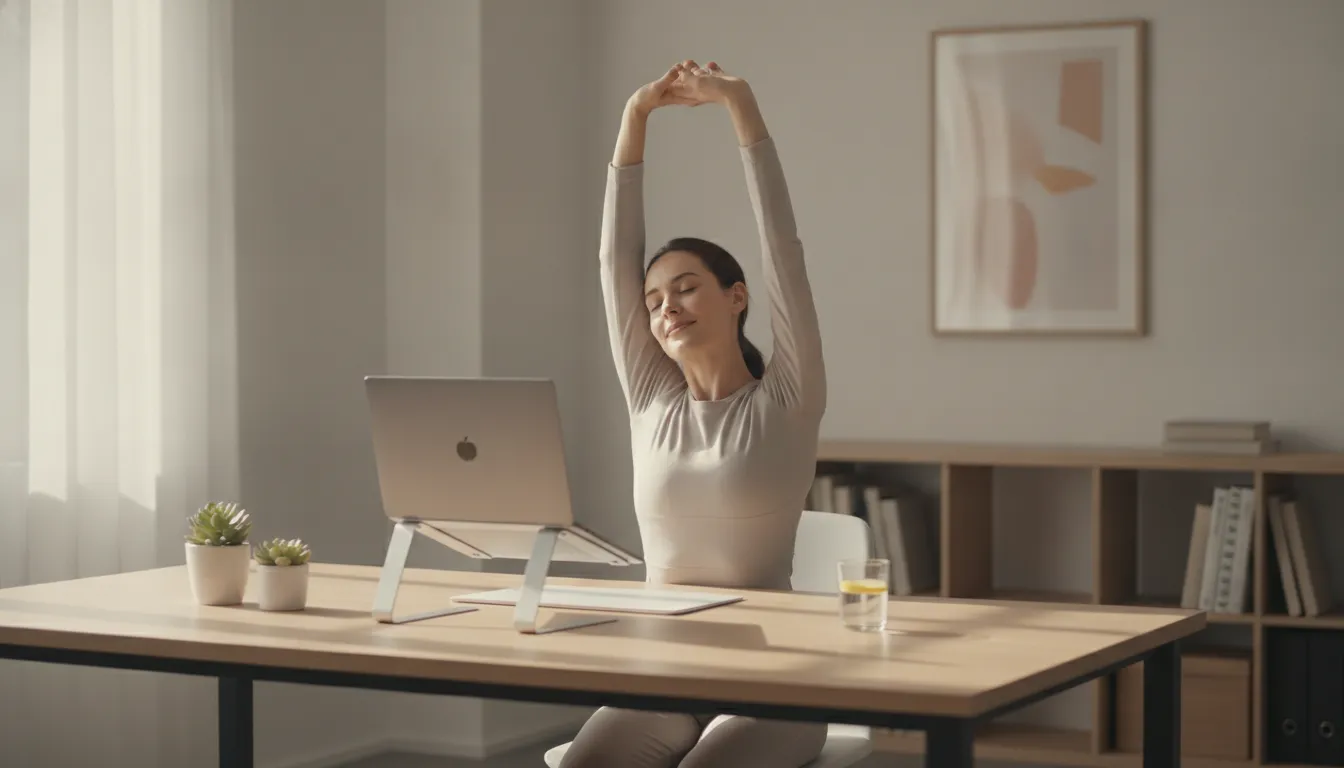
Caring for your body throughout the workday doesn’t have to be complicated or require free hours. Small breaks, simple movements, and paying attention to the signals your body sends are already concrete forms of self-care. The key is regularity and kindness—with your body and your own expectations.
If you’re just starting, you don’t need to do everything at once. Choose one or two movements that seem accessible, try them this week, and observe how you feel. Movement is a language the body understands—and responds to over time.
Take good care of yourself.
> Important Note: This content is informative and educational, produced based on general information available in health literature. It does not replace the evaluation, diagnosis, or treatment by a qualified health professional. In case of doubts about your health, always seek a doctor, physiotherapist, or other qualified professional.
- The pain radiates to arms or legs, or is accompanied by tingling or weakness
- You feel persistent or intense pain in the back, neck, shoulders, or limbs
- Heel Raises: Standing (you can use a table or chair for support), lift your heels off the ground and lower slowly. Repeat 10 to 15 times. This movement often stimulates circulation in the legs.
- Light Spine Extension: Standing, place your hands on your lower back and gently lean your torso backward. This movement can help counterbalance prolonged flexion.
- Shoulder Rotation: With your arms relaxed alongside your body, make slow circles with your shoulders—first forward, then backward. Repeat 5 to 8 times in each direction.
- Breathe. Holding your breath during stretches is a common mistake. Keep your breathing calm and continuous.
- Lower back pain or discomfort, which may be related to lack of support or the posture adopted for hours