

Improve Work Posture: Where to Start
Have you ever reached the end of a workday feeling that familiar tension in your shoulders, a dull neck pain, or lower back fatigue that seems heavier than it should? If the answer is yes, you’re far from alone. With the rise of hybrid and remote work — a trend that has only solidified in recent years — many people spend eight, ten, or even twelve hours a day in front of screens, often in improvised chairs, inadequate desks, or positions that the body simply wasn’t designed to sustain for that long.
The good news is that paying attention to work posture is an accessible starting point for caring for your musculoskeletal health. It’s not about becoming “stiff as a soldier” or following impossible rules, but about understanding small adjustments that, over time, tend to contribute to more comfort and quality of life. This article brings together evidence-based information to help you take the first steps — always remembering that each body is unique and that a health professional is best suited to guide your specific case.
Before diving into practical tips, it’s worth clarifying an important point: “perfect” posture is a concept that science itself is revisiting. Research in physical therapy and ergonomics has shown that the problem is rarely an isolated position, but rather a lack of movement and variation throughout the day. With this in mind, let’s explore what really makes a difference.
What Science Says About Posture and Sedentary Work
The relationship between long hours of sitting and musculoskeletal discomfort is well documented in scientific literature. Organizations like the World Health Organization (WHO) and the National Institute for Occupational Safety and Health (NIOSH) recognize prolonged sedentary work as a risk factor for musculoskeletal disorders, especially in the spine, neck, and upper limbs.
In Brazil, the Ministry of Health and the Ministry of Labor address the topic through regulatory standards — such as NR-17, which deals with ergonomics — reinforcing companies’ responsibility to provide adequate working conditions. But regardless of the work environment, understanding basic ergonomics principles can help anyone make more conscious choices in their daily life.
A key concept here is postural load: the effort that muscles, tendons, and joints make to maintain the body in a certain position. When this load is maintained statically and for prolonged periods — like staying motionless for hours — tissues become overloaded. Varying positions and taking regular breaks are, according to experts in the field, fundamental strategies for reducing this impact.
Basic Ergonomics: Adjusting Your Workspace
You don’t need a sophisticated office to improve your ergonomics. Many adjustments are simple and low-cost. Here’s where to start:
The Chair
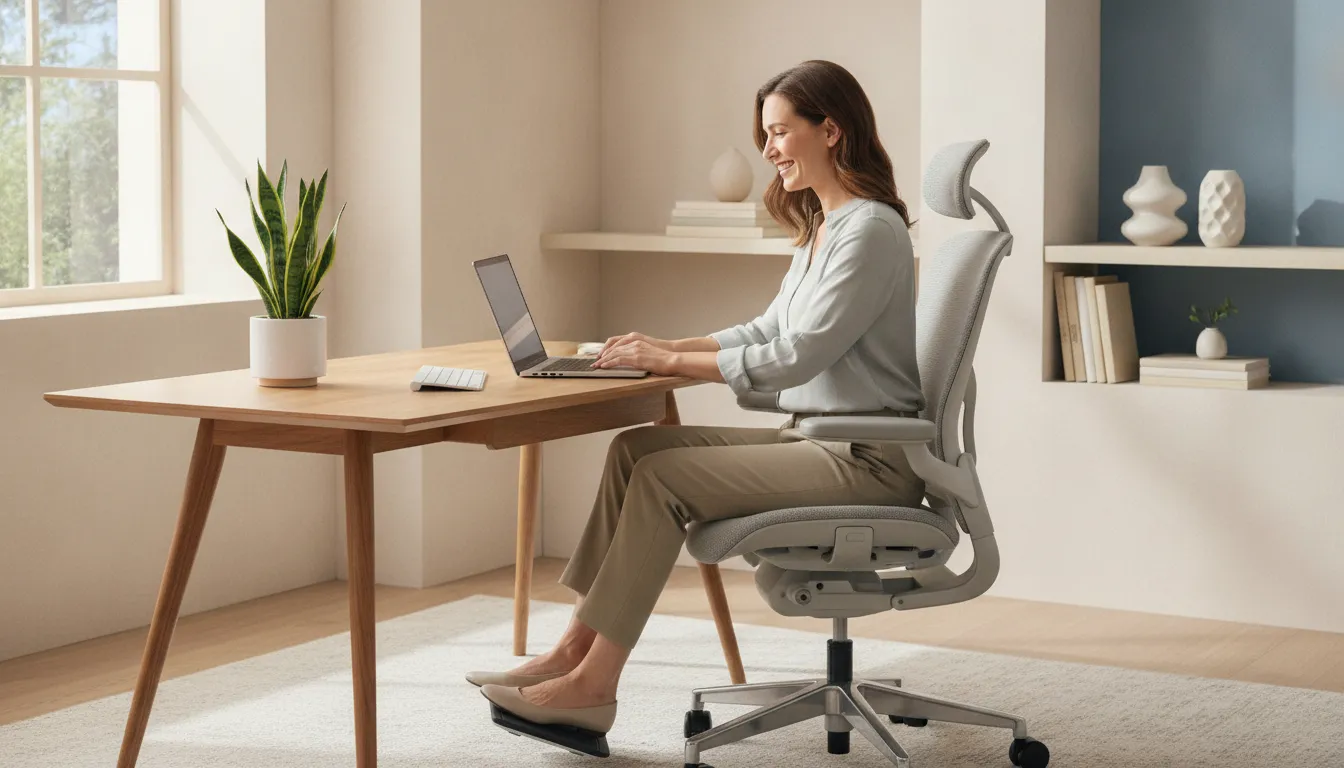
- The seat should allow your feet to rest on the floor (or on a footrest), with knees at approximately a 90-degree angle.
- The backrest should support the lower back region, especially the natural curve of the lower back.
- If the chair doesn’t have adequate lumbar support, a small pillow or rolled towel can be used temporarily.
The Desk and Monitor
- The desk surface should be at a height that allows your elbows to be close to 90 degrees while typing.
- The monitor should be at eye level or slightly below, at a distance of approximately an arm’s length.
- Monitors that are too low or too high strain the neck and can contribute to cervical tension.
The Keyboard and Mouse
- Should be close enough that your shoulders remain relaxed — without needing to “reach” for the accessories.
- Wrist rests can help in some cases, but aren’t recommended for everyone. An ergonomics professional or physical therapist can provide better guidance on this.
Laptop Work
Laptops are practical, but ergonomically challenging: the screen and keyboard are connected, making it impossible to position them adequately at the same time. Using a stand to elevate the laptop + external keyboard and mouse is a solution that often helps quite a bit.
The Importance of Breaks and Movement
If there’s one message that contemporary ergonomics repeats consistently, it’s this: the best positioning is one that changes frequently. Staying in the same posture, even if technically “correct,” for hours on end, is something the body doesn’t tolerate well.
Studies suggest that breaking up sitting time with small movement breaks can help reduce musculoskeletal discomfort and overall fatigue. Some practical strategies:
- The 30-60 minute rule: try to stand up or change position every 30 to 60 minutes. It doesn’t need to be for long — a few minutes already makes a difference.
- Active micro-breaks: take the opportunity to grab a glass of water, make a call standing up, walk to another part of the house or office.
- Simple stretches: gentle movements of the neck, shoulders, and back throughout the day usually help relieve accumulated tension. A physical therapist can recommend the most appropriate ones for your profile.
- Reminders on your phone or computer: ergonomic break apps or simple alarms can be useful allies for those who tend to get “lost” in their work.
Talking about physical activity and its effects on the body and mind is also relevant here: maintaining a regular exercise routine, in addition to work breaks, usually contributes to muscle and joint health broadly.
Posture and Mental Health: A Connection Worth Attention
It may seem that posture is a purely physical matter, but the relationship between body and mind is closer than we imagine. There is research investigating how emotional states influence muscle tension and vice versa — and anyone who’s gotten a “stiff” neck during periods of intense stress probably recognizes that experience.
Chronic stress, anxiety, and burnout can increase muscle tension and make the body more vulnerable to postural discomfort. At the same time, work environments that demand much and offer little autonomy tend to be contexts of greater physical and emotional strain.
Taking care of posture, therefore, can be part of a broader approach to self-care — which includes attention to sleep, balanced nutrition, hydration, and emotional health. Not as an isolated solution, but as one thread in a web of well-being.
Complementary Habits That Often Make a Difference
In addition to adjustments in your work space and breaks, some general habits usually contribute to postural health:
- Adequate hydration: the intervertebral discs of the spine have a large part of their composition in water. Staying well hydrated throughout the day is a simple and important care.
- Quality sleep: during sleep, the body performs muscle and joint recovery processes. A suitable mattress and pillow also count.
- Balanced diet: a varied and nutritious diet supports tissue health in general. There’s no magic food for posture, but nutritional care is part of the context.
- Regular exercise: activities that strengthen the core (deep abdominal and back muscles), such as pilates, yoga, or guided functional exercises, are usually associated with more postural stability — always under professional guidance.
When to See a Health Professional
Ergonomic adjustments and healthy habits are valuable allies, but there are situations where the guidance of a specialized professional is essential. Consult a doctor, physical therapist, or other health professional if you experience:
- Persistent pain or pain that worsens over time, especially in the spine, neck, or limbs
- Tingling, numbness, or weakness in the arms or legs
- Pain that radiates to other regions of the body
- Limitation of movement that interferes with daily activities
- Pain that doesn’t improve after posture adjustments and regular breaks
- History of injuries, surgeries, or pre-existing conditions in the spine or joints
In these cases, self-management has important limits. A professional can investigate the cause of discomfort, perform an individual assessment, and recommend the most appropriate treatment for your situation. Physical therapists are specialists in musculoskeletal health and can provide guidance for both rehabilitation and prevention.
Taking the First Steps: A Simple Roadmap
For those who want to start now, without overwhelming themselves, here’s an initial roadmap:
- Observe your current position: how are you sitting right now as you read this? Where do you feel tension?
- Adjust one element at a time: start with monitor height or foot position. Small changes are more sustainable than radical overhauls.
- Schedule a break per hour: set an alarm to stand up and move your body for a few minutes.
- Keep track of what you feel: a simple diary of discomforts can help identify patterns and communicate better to a health professional, if needed.
- Seek professional guidance: if possible, an ergonomic or physical therapy assessment can bring valuable and personalized insights.
Conclusion
Improving your work posture isn’t about willpower or “toughing it out” — it’s about understanding how your body works and creating conditions for it to feel better throughout the day. Small adjustments to your environment, regular breaks, and attention to the signals your body sends are accessible and well-supported starting points.
Each person has a different story, body, and context. That’s why what works for a colleague might not be ideal for you. Listen to your body, start with simple changes, and whenever doubt or persistent discomfort arises, don’t hesitate to seek out a health professional. Taking care of yourself is always the best investment.
This content is informative and educational, and does not replace evaluation, diagnosis, or treatment by a qualified health professional. Consult a doctor, physical therapist, or other specialist for individualized guidance.