
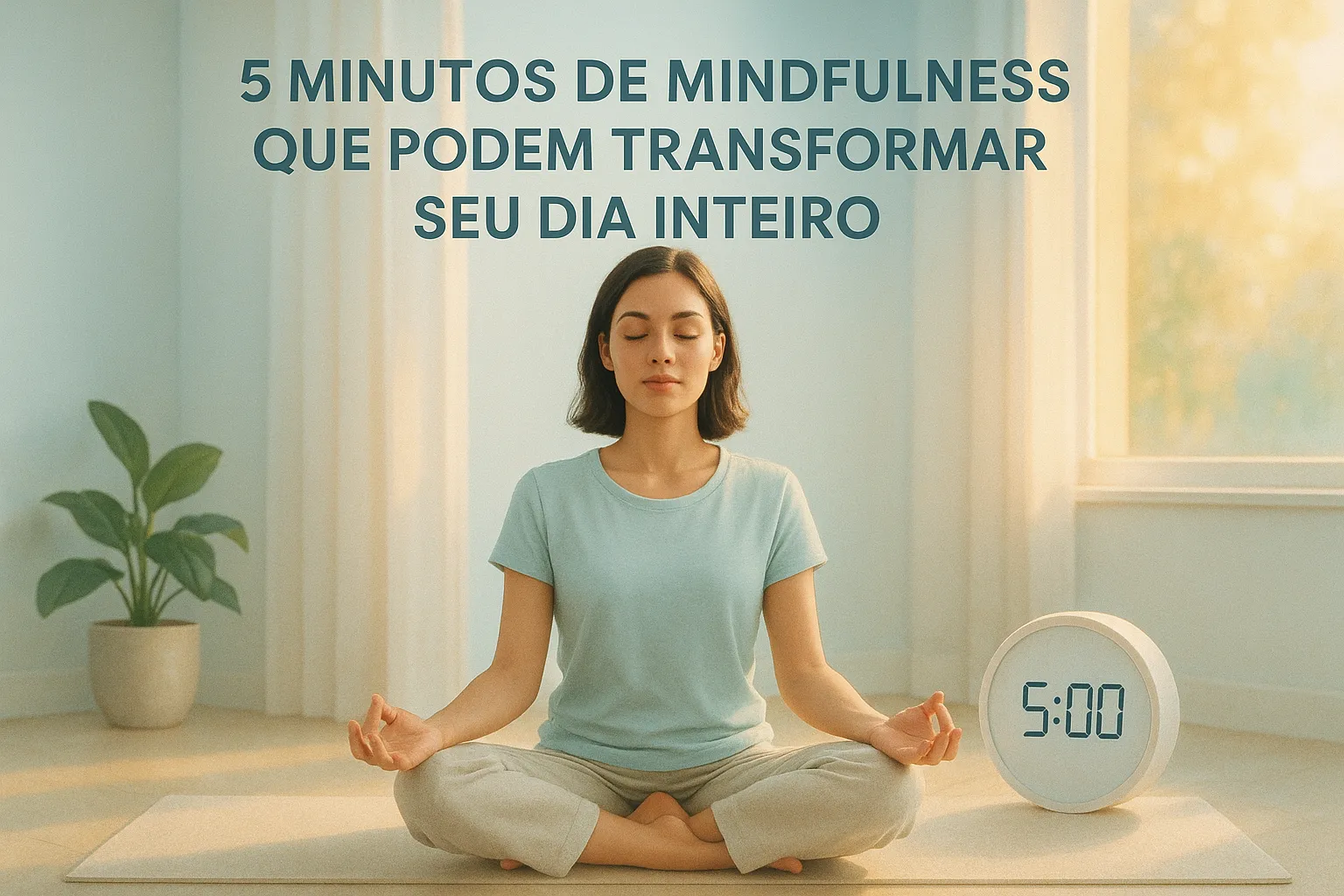
# 5 Minutes of Mindfulness That Can Transform Your Entire Day
In the fast-paced rhythm of modern life, finding moments of peace and mental clarity seems like an unattainable luxury. We wake up in a rush, hurry to work, deal with endless demands, and before we know it, the day is over without dedicating even a moment to ourselves. The good news is that you don’t need hours of meditation in a silent retreat to experience the profound benefits of mindfulness. Just five minutes of conscious practice can be enough to completely transform your day, your perspective, and gradually, your entire life.
Mindfulness, or full attention, is the practice of being present in the current moment, observing thoughts, sensations, and emotions without judgment. Scientific research has consistently shown that this ancient practice offers measurable benefits for mental and physical health. According to studies published by the American Psychological Association, short and regular mindfulness sessions can significantly reduce stress levels, improve concentration, and increase overall well-being.
This article will guide you through simple yet powerful practices that require only five minutes of your day but have the potential to create waves of transformation that extend throughout the following hours.
## Why Just 5 Minutes Are Enough
Many people avoid starting a mindfulness practice because they believe they need long periods of free time. This belief is one of the biggest obstacles preventing more people from experiencing the benefits of full attention. The truth is that consistency outweighs duration when it comes to cultivating mindfulness.
Neuroscientific studies reveal that even brief periods of meditation can activate brain areas associated with emotional regulation and self-awareness. A study from Harvard University demonstrated that eight weeks of daily meditative practice, even in short sessions, can alter brain structure, increasing gray matter density in regions related to memory, empathy, and stress management.
Five minutes are enough to:
– Interrupt the automatic cycle of reactive thoughts
– Reset your nervous system
– Create a space between stimulus and response
– Establish a conscious intention for the day
– Reconnect with your body and breath
The secret is not in the duration but in regularity. Five minutes every day create a sustainable habit that naturally integrates into your routine without causing resistance or a sense of overload. To complement this practice with other well-being strategies, it’s worth knowing how to transform your life through self-help.
## Conscious Breathing: Your Anchor to the Present
Breathing is the foundation of any mindfulness practice. It is always accessible, happens in the present moment, and serves as a bridge between mind and body. When you direct your attention to your breath, you automatically anchor yourself in the now, moving away from future worries or past ruminations.
**5-Minute Practice: Conscious Breathing**
1. **Find a comfortable position** – Sit in a chair with your feet on the ground or on a cushion on the floor. You can also do this lying down, although this may increase the tendency to fall asleep.
2. **Set your intention** – Dedicate these five minutes just to being present. There is nothing to achieve, just be.
3. **Observe your natural breath** – Without trying to change it, simply notice how the air enters and exits. Feel the coolness of the air entering through your nostrils and the warmth as it leaves.
4. **Count your breaths** – Inhale counting “one,” exhale counting “two,” inhale counting “three,” and so on up to ten. Then return to one. This helps maintain focus.
5. **When the mind wanders (and it will)** – Gently and without judgment, acknowledge that your mind wandered and bring it back to the breath. This is the practice: noticing distraction and returning.
6. **End with gratitude** – In the last 30 seconds, thank yourself for dedicating this time to yourself.
This simple practice activates the parasympathetic nervous system, responsible for the body’s relaxation response. Over time, you will develop the ability to access this state of calm quickly, even in stressful situations. To deepen this journey of serenity, explore techniques to achieve inner peace.
## Body Scan: Reconnecting with Your Physical Sensations
We spend much of the day “living in our heads,” disconnected from bodily sensations. This disconnection can lead to the accumulation of physical tension and a decreased awareness of important signals the body sends us. Body scanning is a mindfulness technique that reconnects mind and body through directed attention.
**5-Minute Practice: Quick Body Scan**
1. **Position yourself comfortably** – Preferably sitting or lying down.
2. **Start with your feet** – Direct your attention to your toes. Observe any sensations: warmth, cold, tingling, pressure, or even absence of sensation.
3. **Gradually move up** – Move your attention from your feet to your ankles, calves, knees, thighs, hips, abdomen, chest, back, shoulders, arms, hands, neck, face, and top of your head.
4. **Observe without judging** – If you find areas of tension, simply acknowledge them. There’s no need to “fix” anything. Conscious attention often releases tension.
5. **Breathe into tense areas** – If desired, imagine your breath flowing into areas of discomfort, bringing relaxation.
6. **Finish with a global awareness** – In the last seconds, feel your body as a whole, integrated and present.
This practice increases proprioception (body awareness) and helps identify and release tensions before they turn into chronic pain or bigger problems. It also strengthens the mind-body connection, essential for overall well-being. Sleep quality can also improve significantly with this practice, as shown by the benefits of a good night’s sleep.
## Conscious Gratitude: Transforming Your Perspective
Neuroscience has confirmed what contemplative practices have taught for millennia: gratitude literally rewires the brain. When we practice gratitude consciously, we activate the medial prefrontal cortex and strengthen neural pathways associated with positive emotions and well-being.
**5-Minute Practice: Gratitude Reflection**
1. **Create a quiet space** – Sit comfortably and close your eyes or maintain a soft gaze.
2. **Start with three deep breaths** – This signals to the body that you are entering a space of conscious reflection.
3. **Identify three specific things** – Think of three things you are grateful for today. Be specific: instead of “my family,” think “the warm hug I received in the morning” or “the laughter shared at breakfast.”
4. **Genuinely feel** – Don’t just list mentally. Allow yourself to feel the emotion of gratitude in your body. Where do you feel it? In the chest? Throat? Face?
5. **Expand to the unexpected** – Consider something challenging for which you can be grateful, as it taught you something or made you grow.
6. **Send gratitude to yourself** – Acknowledge something positive about yourself: a quality, a choice, an effort.
This practice is not about denying difficulties or forcing toxic positivity. It’s about training the mind to notice what is working, creating balance in the brain’s natural tendency to focus on problems and threats. Over time, you will develop a more positive orientation towards life without losing realism.
## Observing Thoughts: Creating Healthy Distance
One of the most liberating insights of mindfulness is understanding that you are not your thoughts. They are mental events that arise and pass, like clouds in the sky. When we identify too much with each thought, we become at the mercy of automatic and often negative mental patterns.
**5-Minute Practice: Thought Observer**
1. **Assume the position of observer** – Imagine yourself sitting by a riverbank, watching the waters flow. Or visualize yourself watching the sky as clouds pass.
2. **Notice thoughts arriving** – When a thought arises, simply acknowledge: “Ah, a thought about work” or “A worrying thought appeared.”
3. **Avoid engaging** – Don’t analyze, don’t judge, don’t develop the thought. Just observe its presence and transient nature.
4. **Name categories if it helps** – “Planning,” “Memory,” “Worry,” “Fantasy.” This naming creates healthy distance.
5. **Return to the breath** – Use the breath as an anchor whenever you find yourself lost in a line of thought.
6. **Cultivate curiosity, not criticism** – If you become frustrated with recurring thoughts, observe this frustration as just another passing thought.
This practice develops metacognition – the ability to think about thinking. This creates psychological flexibility and reduces the power that automatic mental patterns have over you. Over time, you will realize you can choose which thoughts to focus on and which to let pass. This skill is fundamental for <a href="https://s