Have you ever felt that familiar sensation of a racing heart, tight chest, and spiraling thoughts that seem impossible to stop? Anxiety is part of the human experience — it’s a natural response of our nervous system to perceived threats. The problem arises when this response becomes frequent, intense, or disproportionate to the context, interfering with quality of life and daily well-being.
The good news is that there are simple, accessible tools with growing scientific support that can help ease these moments of tension. Among them, breathing techniques stand out for a very concrete reason: the way we breathe has a direct connection with our autonomic nervous system — the set of mechanisms that regulate automatic body functions, such as heartbeat, digestion, and stress response.
This article provides educational information about some of these techniques, how they work, and how they can be incorporated into your routine. Remember: this content is informative and does not replace the evaluation of a health professional. If you feel that anxiety is significantly impacting your life, seeking support from a psychologist or psychiatrist is always the best course of action.
Why Does Breathing Influence Anxiety?
To understand the role of breathing in managing anxiety, it’s useful to know a basic concept: the autonomic nervous system has two main branches — the sympathetic system, associated with the “fight or flight” response, and the parasympathetic system, associated with rest and recovery.
When we feel anxious, the sympathetic system is activated: breathing becomes rapid and shallow, the heart races, muscles tense up. This process has an important evolutionary function — preparing the body to react to a threat. The challenge is that, in the contemporary world, many of our “triggers” are psychological and do not require a physical response.
This is where conscious breathing comes into play. Studies published in neuroscience and psychology journals suggest that slow and controlled breathing can stimulate the vagus nerve, a central structure of the parasympathetic system, contributing to a sense of calm. Unlike many interventions, breathing is one of the few body functions we can voluntarily control, making it an especially interesting tool.
Technique 1: Diaphragmatic (Abdominal) Breathing
Diaphragmatic breathing is considered the foundation of many relaxation practices. In the daily stress, we tend to breathe shallowly, using only the upper part of the chest. Abdominal breathing invites the diaphragm — the muscle located below the lungs — to actively participate in the process.
How to Practice
Sit comfortably or lie on your back.
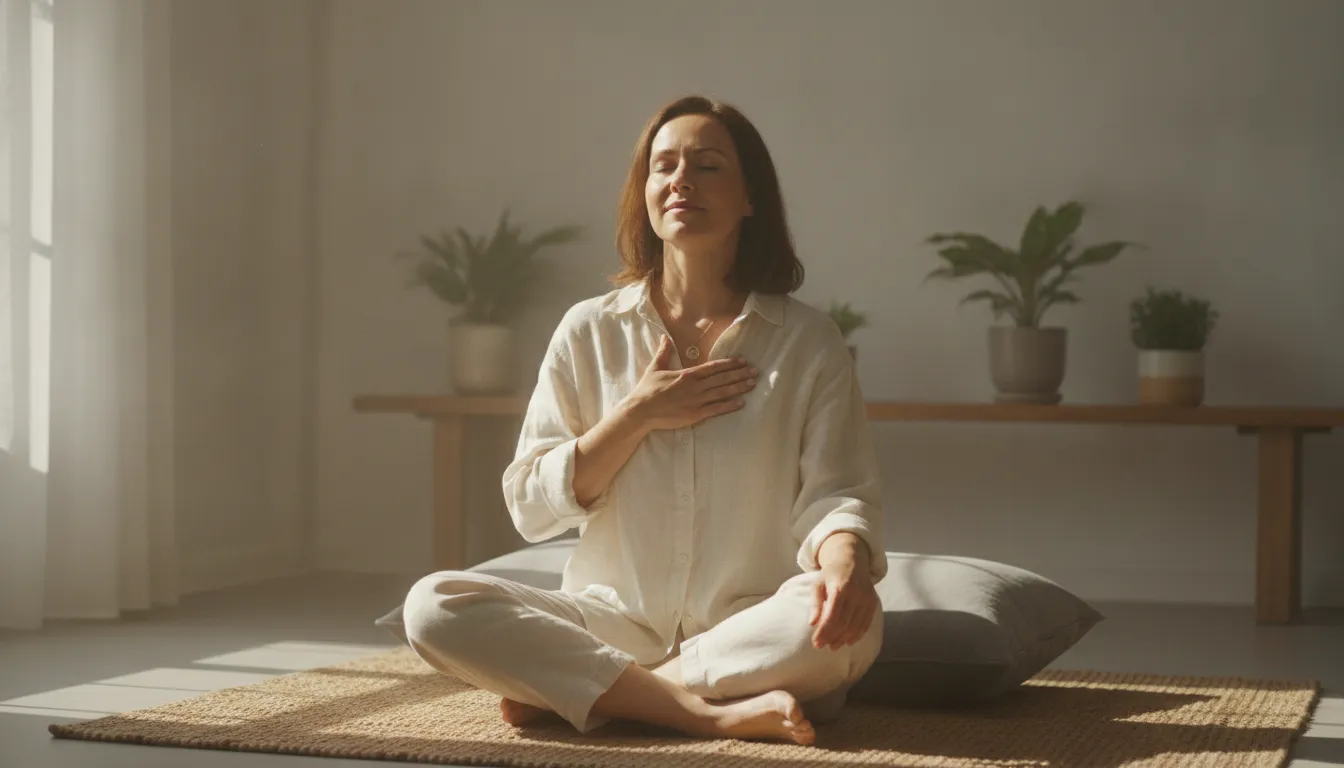
Place one hand on your chest and the other on your abdomen.
Inhale slowly through your nose, allowing the abdomen to expand (the hand on the abdomen should rise; the hand on the chest should remain relatively still).
Exhale through your nose or mouth, feeling the abdomen gently contract.
Repeat for a few minutes, keeping a calm rhythm without forcing.
This technique is often recommended by health professionals as a starting point precisely because it is accessible and low-risk for most people.
Technique 2: 4-7-8 Breathing
Popularized in the context of integrative medicine practices, 4-7-8 breathing proposes a specific rhythm of inhalation, retention, and exhalation. The idea is that prolonged exhalation can contribute to the activation of the parasympathetic system.
How to Practice
Exhale completely through your mouth, making a slight sound as you release the air.
Close your mouth and inhale through your nose while mentally counting to 4.
Hold your breath while counting to 7.
Exhale completely through your mouth (with the slight sound) while counting to 8.
This complete cycle equals one breath. Repeat 3 to 4 times initially.
Note: Individuals with respiratory, cardiovascular conditions, or who are pregnant should consult a healthcare professional before trying techniques with breath retention.
Technique 3: Box Breathing
Used in contexts ranging from military training to corporate wellness programs, box breathing proposes four steps of equal duration, as if tracing the sides of a square.
How to Practice
Exhale slowly until your lungs are empty.
Inhale through your nose while counting to 4.
Hold your breath while counting to 4.
Exhale through your mouth while counting to 4.
Wait with empty lungs while counting to 4.
Repeat the cycle for a few minutes.
Studies suggest that this type of rhythmic breathing can contribute to reducing the stress response, although research is still developing and results may vary among individuals.
With roots in yoga tradition, alternate nostril breathing has been studied in Western contexts of mental health and well-being. Preliminary research suggests that this practice may be associated with reduced heart rate and a greater sense of balance, although the body of evidence is still limited and more studies are needed.
How to Practice
Sit in a comfortable position with your spine straight.
With your right hand, position your thumb beside your right nostril and your ring finger beside your left nostril.
Close your right nostril with your thumb and inhale slowly through your left nostril.
Close both nostrils for a brief moment.
Open your right nostril and exhale slowly through it.
Coherent breathing involves breathing at a rate of approximately 5 to 6 cycles per minute — that is, inhaling for about 5 seconds and exhaling for about 5 seconds. This specific rhythm has been investigated in studies related to heart rate variability (HRV), a marker associated with the balance of the autonomic nervous system.
Research published in psychiatry and psychosomatic medicine journals suggests that regular coherent breathing practices may be associated with reduced anxiety symptoms and increased well-being. It is one of the techniques with the most consistent evidence so far — although researchers emphasize the need for larger-scale and longer-duration studies.
To practice, you can use guided breathing apps or simply count mentally, maintaining equal-duration inhalations and exhalations, around 5 seconds each.
How to Incorporate These Practices into Your Routine
Regularity often makes a bigger difference than the duration of each session. Some practical suggestions:
Start small: 5 minutes a day can already be a consistent starting point.
Choose anchor moments: before sleeping, upon waking, before important meetings, or during breaks throughout the day.
Try different techniques: each person responds differently; observe which one feels more comfortable for you.
Combine with other wellness practices: breathing techniques can be integrated into meditation, conscious movement (like yoga or tai chi), or therapeutic practices when recommended by a professional.
Don’t force or judge: if attention wanders, it’s completely normal. Gently returning to the breath is already part of the exercise.
Breathing techniques are complementary tools and support overall well-being — they do not replace professional evaluation or treatment. It is important to seek help from a psychologist, psychiatrist, or doctor when:
Anxiety is frequent, intense, or persistent, interfering with work, relationships, or daily activities.
You experience frequent physical symptoms without an identified cause, such as palpitations, shortness of breath, or chest pain (in these cases, medical evaluation is essential to rule out physical causes).
Breathing techniques do not bring any relief or cause discomfort.
You feel emotionally overwhelmed and without perspective.
There are thoughts of self-harm or that life is not worth living.
If you are in intense distress or crisis, know that help is available. In Brazil, the CVV (Centro de Valorização da Vida) is available at 188, with free calls, 24 hours a day, 7 days a week. In emergencies, seek the nearest health service or SAMU (192).
Conclusion
Breathing seems simple — after all, we do it all the time without thinking. But bringing awareness and intention to this process can be a powerful gesture of self-care. The techniques presented here are tools that can help create moments of pause, ease the stress response, and enhance body awareness — not as definitive solutions, but as valuable allies on the path to well-being.
Remember that taking care of mental health is a continuous act, involving self-awareness, human support, and, when necessary, professional guidance. You don’t need to walk this path alone.
This content is informative and educational, produced by health and wellness writers. It does not replace evaluation, diagnosis, or treatment by a qualified health professional. Always consult a doctor, psychologist, or other qualified professional for guidance appropriate to your specific case.