

Why Putting Thoughts on Paper Benefits Your Mind
Have you ever felt like your head is so full of thoughts that it’s hard to breathe? Work worries, relationship concerns, daily decisions, emotions with nowhere to go — all of this can accumulate in ways that directly affect mental and physical wellbeing. In this scenario, a simple and ancient practice has been gaining increasing attention from researchers and mental health professionals: keeping a personal journal.
It’s not a habit reserved for teenagers or writers. The act of writing about your own life, feelings, and experiences can be an accessible self-care tool for people of any age. In 2026, with life becoming increasingly fast-paced and digitally connected, finding spaces for pause and reflection has become even more valuable — and a journal offers exactly that: a place of your own, without judgment.
In this article, you’ll understand what studies say about this practice, how it can contribute to mental health, and how to start — without pressure and at your own pace.
What Science Says About Writing About Yourself
Expressive writing, which involves recording thoughts and emotions in a free and personal way, has been studied for decades. James Pennebaker, a psychologist at the University of Texas, conducted research starting in the 1980s that helped popularize the topic. His studies suggest that writing about emotionally difficult experiences may be associated with benefits for mood and even some indicators of physical health — though the exact mechanisms are still being studied by the scientific community.
More recent research, published in peer-reviewed journals such as the Journal of Experimental Psychology, suggests that writing about emotions can help organize fragmented thoughts, reduce mental rumination (that cycle of repetitive thoughts that usually worsens anxiety), and increase the sense of internal clarity.
It’s important to be honest: results vary from person to person, and journaling is not a clinical treatment nor does it replace professional care. What studies suggest is that it can be a useful complement to mental health care — a tool among many others.
How Journaling Can Contribute to Emotional Wellbeing
Keeping a journal can help in several practical and emotional ways. See some of the most studied:
- Organizing thoughts: When we write, we’re forced to give shape to something that often exists in a chaotic way in our minds. This process can bring more clarity about what we’re really feeling.
- Recognizing emotions: Naming an emotion — realizing that what you feel is frustration, not anger, for example — is an important step in dealing with it more healthily. Psychologists call this “emotional labeling,” and research suggests it can reduce the intensity of difficult emotional responses.
- Processing difficult experiences: Writing about challenging situations can help create a more understandable narrative about them, which usually contributes to a sense of resolution or acceptance.
- Self-knowledge: Over time, rereading old journal entries can reveal patterns of behavior, emotional triggers, and personal growth that would go unnoticed in daily routine.
- Stress reduction: Some studies suggest that expressing worries in writing can relieve the cognitive burden they represent — almost like “unloading” part of the mental weight onto paper.
Types of Journals: Find What Works for You
There’s no single right way to keep a journal. The best format is one you can maintain consistently and that resonates with your personality.
Free Writing
No rules, no structure. You write whatever comes to mind, for as long as you want. It’s especially useful for processing intense or confusing emotions.
Gratitude Journal
Focus on recording, daily, things you’re grateful for. Studies suggest that gratitude practices may be associated with greater subjective wellbeing — though science still investigates the mechanisms behind this.
Emotional Record Journal
You note situations from your day, the emotions that arose, and the thoughts associated with them. This approach connects to techniques used in cognitive-behavioral therapy (CBT) and can be especially interesting for those in therapy who want to deepen the work outside sessions — always with your professional’s guidance.
Emotional Bullet Journal
Combines visual elements, lists, and quick records. It’s an option for those who prefer something more dynamic and less text-heavy.
Digital or Analog Format
Physical notebook or notes app — the choice is yours. Many people report that handwriting has something more reflective and slowing about it, but what matters is what works for you.
How to Start: A Step-by-Step Guide Without Pressure
Starting can seem intimidating, especially if you don’t consider yourself a “writing person.” But a personal journal doesn’t require literary talent — it only requires honesty with yourself.
- Choose a comfortable medium. It could be a simple notebook, an old planner, or a notes app on your phone. What matters is that you feel comfortable with it.
- Set a time of day. Many people prefer morning, to organize their thoughts before starting the day, or evening, to process what happened. There’s no right time — there’s what works for you.
- Start with little time. Five to ten minutes are enough to begin. You don’t need to write long texts.
- Write without censoring yourself. Your journal is a private space. Don’t worry about grammar, style, or what others will think — no one needs to read it.
- Use questions as a starting point. If you don’t know where to start, try answering: “What am I feeling right now?”, “What worried me today?”, “What brought me joy this week?”
- Be consistent, but gentle with yourself. Skipping days isn’t failure. Your journal will always be there when you want to return.
- Reread eventually. Over time, looking at old entries can be a revealing and often comforting experience.
Journaling as Part of a Self-Care Routine
A journal works best when integrated into a lifestyle that values wellbeing broadly. It can walk alongside other practices that usually contribute to mental health, such as regular physical movement, quality sleep, meaningful social connections, and time in nature — and if you’re curious about how contact with natural environments can affect your body and mind, it’s worth reading Nature and Wellbeing: What Happens to Your Body.
For those dealing with daily anxiety, combining journaling with other emotional regulation tools — such as breathing techniques that help control anxiety — can make your self-care routine even more complete.
When Journaling Isn’t Enough: Know When to Seek Professional Help
Journaling is a self-care tool, not a treatment. There are situations where it can even be a starting point for recognizing that you need professional support — and that’s very valid.
Consider talking with a psychologist, psychiatrist, or other mental health professional if you notice:
- Persistent sadness, anxiety, or irritability lasting weeks and affecting your routine
- Difficulty sleeping, eating, or performing basic daily activities
- Feelings of hopelessness, worthlessness, or emptiness that don’t go away
- Disturbing thoughts that repeat and cause intense suffering
- Feeling like you can’t cope alone with what you’re feeling
Remembering that asking for help is an act of care, not weakness, is an important step. Mental health professionals are prepared to offer appropriate support for each situation.
If you’re going through a crisis or intense suffering, know that help exists. In Brazil, the CVV (Center for the Valorization of Life) offers free assistance by phone 188, 24 hours a day, every day. In emergencies, seek the nearest emergency room.
Conclusion: A Notebook, A Space of Your Own
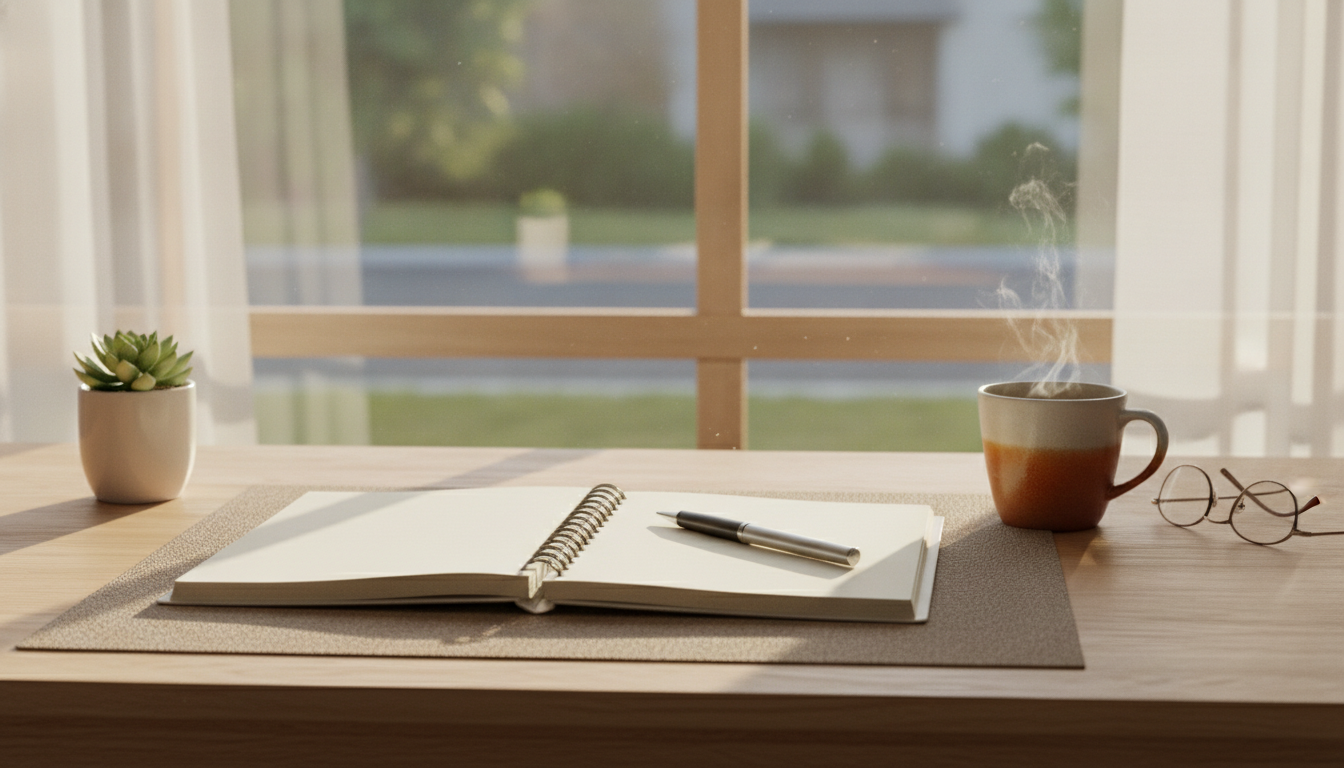
Keeping a personal journal is a simple gesture that can have a significant impact on how you relate to your own thoughts and emotions. It requires no financial investment, special equipment, or specific skill — only a willingness to look at yourself with honesty and kindness.
If you haven’t tried it yet, why not give it a chance? A notebook and a few minutes a day could be the beginning of a practice that, over time, often becomes a valuable refuge.
And remember: taking care of your mental health is an ongoing process, combining healthy habits, human connections, and, when necessary, support from qualified professionals. Journaling can be a beautiful piece of that puzzle — but the complete picture is made with so much more.
This content is informative and educational, produced by health and wellness writers, and does not replace evaluation, diagnosis, or treatment by a health professional. Each person has individual needs, and only a qualified professional can advise on appropriate care for your case.