Small Food Choices That Make a Healthier Diet
Have you ever stopped to think about how many food-related decisions you make in a single day? From what you put in your first meal in the morning to the snack before bed, these choices accumulate — and over time, they tend to have a significant influence on how you feel, sleep, expend energy, and deal with your day-to-day life. The good news is that improving your diet doesn’t have to start with radical transformation, nor with restrictive diets that require superhuman willpower.
The science of nutrition has advanced significantly in recent years, and one of the most consistent learnings is that small, sustainable adjustments tend to generate more lasting results than drastic changes that are difficult to maintain. Organizations like the World Health Organization (WHO) and Brazil’s Ministry of Health emphasize that a balanced diet is one that is varied, colorful, with a predominance of natural and minimally processed foods — without excessive rigidity or guilt.
This article brings together general, evidence-based guidance for those who wish to take concrete and gentle steps toward a healthier relationship with food. Remember: each person has their own story, routine, and unique needs. Therefore, the tips here are a starting point — they do not replace the guidance of a nutritionist or healthcare professional who knows your case.
Why Small Changes Work Better Than Big Revolutions
When we try to change everything at once — cutting out entire food groups, following fixed meal plans, counting every gram of what we eat — the process tends to be stressful and difficult to sustain. Research in behavioral psychology suggests that smaller, more gradual changes are easier to incorporate into your routine because they require less conscious effort over time.
Moreover, the relationship with food goes far beyond nutrition itself. It involves culture, pleasure, emotional memory, social context, and even the emotional state of the moment. Ignoring these dimensions tends to make any dietary change harder than it needs to be.
The idea is not to achieve “perfect” eating — which, by the way, doesn’t exist. It’s to cultivate, over time, habits that make sense for your real life.
More Natural Foods, Fewer Ultraprocessed Foods
Brazil’s Food Guide for the Population, from the Ministry of Health, organizes foods by degree of processing and recommends that the basis of a diet be composed of natural or minimally processed foods — fruits, vegetables, legumes, grains, tubers, eggs, meats, and dairy without excessive additives.
Ultraprocessed foods, such as soft drinks, processed meats, industrial snacks, filled cookies, and ready-made meals with long ingredient lists, typically contain high amounts of sodium, added sugars, and saturated fats, plus few essential nutrients. Epidemiological studies associate frequent consumption of these products with worsening health markers over time — but it’s important to note that a healthy diet is about proportion, not prohibition.
Some practical ways to increase natural foods:
- Gradually replace one ultraprocessed food per day with a less processed option
- Keep washed fruits accessible at home, making healthy impulse eating easier
- Try seasoning rice and beans with fresh herbs instead of industrial ready-made seasonings
- When shopping, first browse the produce, grain, and fresh protein sections
The Importance of Color on Your Plate
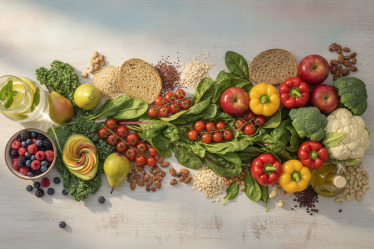
When your plate has a variety of colors, it usually reflects a variety of nutrients. Each plant pigment carries different bioactive compounds — the lycopene in tomatoes, the anthocyanin in purple beets, the beta-carotene in carrots, the chlorophyll in green leaves. These compounds are studied for their role in inflammatory processes, immunity, and cell health, although the mechanisms are still the subject of ongoing research.
You don’t need to memorize nutrient names. A simple strategy: try to include at least three different vegetable colors throughout the day. It could be a banana at breakfast, lettuce and tomato at lunch, and a carrot as a snack — that’s already a good start.
Attention to Sodium and Added Sugar
Two components that deserve special attention in contemporary eating are sodium and added sugar. The WHO recommends that adults limit their consumption of salt and free sugars — while not setting rigid numbers here, but signaling that current consumption patterns in many countries, including Brazil, tend to be above what is considered ideal.
The problem isn’t salt in homemade food, but the sodium “hidden” in ready-made sauces, industrial breads, cold cuts, and canned foods. The same goes for sugar: it’s not the sugar naturally present in fruits, but the sugar added to beverages, industrial yogurts, sauces, and snacks.
Simple steps to reduce without suffering:
- Taste your food before adding salt — sometimes the seasoning is already sufficient
- Try replacing some salt with aromatic herbs (rosemary, basil, oregano, lemon)
- Prefer water, sparkling water, or unsweetened tea instead of sweetened beverages
- Read food labels: ingredients listed at the beginning appear in greater amounts
- Reduce gradually — your taste buds adapt over time
Eating With Awareness: What is Mindful Eating
Mindful eating — or mindful eating — is an approach based on mindfulness practices applied to the act of eating. Studies suggest that eating slowly, with attention to flavor, texture, and sensations of hunger and fullness, can contribute to a more balanced relationship with food.
In everyday practice, this can mean:
- Having meals without screens (phone, TV) at least a few times a week
- Chewing slowly and noticing when you start to feel full
- Eating seated at the table, even if just for 10 or 15 minutes
- Identifying whether hunger is physical or emotional — without judgment
This doesn’t mean every meal needs to be a meditative ritual. It’s about gradually cultivating more awareness and less automatism.
Hydration: The Simplest and Most Often Neglected Habit
Water is involved in practically every physiological process in the body — temperature regulation, nutrient transport, kidney function, digestion, among others. Despite this, many people end the day with liquid consumption far below what their body needs.
Hydration needs vary from person to person, depending on weight, climate, physical activity level, and health conditions. There is no universal number. What usually helps is creating reminders and making water accessible:
- Keep a water bottle always visible on your work or study desk
- Start your day with a glass of water before any other beverage
- If you have difficulty with neutral-tasting water, try adding lemon slices, mint, or cucumber
- Observe the color of your urine: clear coloration (pale yellow) usually indicates good hydration
Remember that sugary drinks and alcohol do not replace water — and alcohol, in fact, has a diuretic effect.
Family Meals and the Social Context of Eating
The act of eating has never been just biological. Eating together — whether with family, friends, or colleagues — is usually associated with more varied food choices, slower meals, and greater satisfaction. The social context of eating is widely recognized in public health research as a relevant factor for overall well-being.
If your routine makes shared meals difficult to have frequently, that’s fine. Even once or twice a week can make a difference. And when you eat alone, value the moment: choose a nice plate, prepare something you like — eating well doesn’t have to be boring or self-sacrificing.
To deepen the relationship between lifestyle and health, it’s worth checking out our article on healthy eating: myths that still confuse many people, which clarifies common beliefs that can hinder good choices.
When to See a Healthcare Professional
General tips have their value, but there are situations where the guidance of a specialized professional is fundamental and should not be delayed:
- When there is a diagnosis of conditions such as diabetes, hypertension, kidney disease, eating disorders, or other chronic diseases that require specific nutritional management
- When you notice significant changes in weight, appetite, or your relationship with food without apparent cause
- When there are frequent physical sensations after eating (intense bloating, pain, discomfort) that persist
- When your relationship with food causes emotional distress, excessive guilt, very rigid restrictions, or episodes of compulsion
The nutritionist is the qualified professional to develop individualized meal plans. The doctor can evaluate associated clinical conditions. And if your relationship with food involves intense emotional distress, a psychologist can be valuable support — these paths can and usually complement each other.
Conclusion
Eating well is not a destination with an arrival time — it’s a continuous process, full of nuances, that changes according to your life stage, routine, and even the emotional state of each period. The small choices you make today — more fruit, less ultraprocessed food, one more glass of water, a more relaxed meal — build, over time, a pattern that can make a real difference in how you feel.
Be kind to yourself in this process. There is no perfect diet, and one unhealthy choice in isolation doesn’t erase a positive pattern built over many days. What matters is the general direction and consistency — not rigidity.
And if you want to go beyond eating habits, the relationship between walking every day and the benefits for your body is another accessible starting point with a good evidence base for those who want to take care of their health in an integrated way.
This content is informative and educational, and does not replace evaluation, diagnosis, or guidance from a healthcare professional. Consult a nutritionist, doctor, or other qualified professional to receive guidance appropriate to your individual situation.