
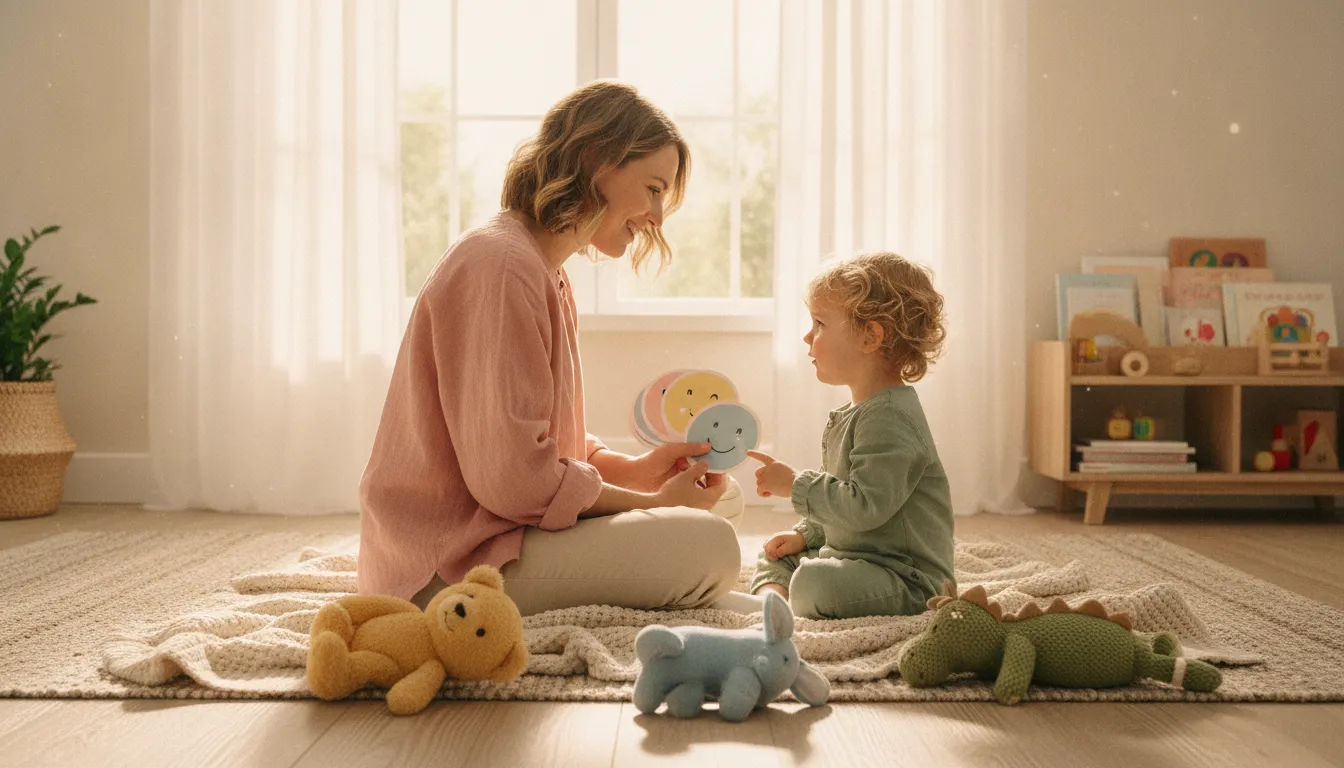
How to Talk About Emotions with Children in a Supportive Way
Imagine a child coming home from school with a frown, throwing their backpack on the floor, and locking themselves in their room. Or a child who cries without being able to explain why, or who has outbursts of anger that seem disproportionate to the situation. For many parents, caregivers, and guardians, these scenes are familiar—and also unsettling. What to do? What to say? How to approach without pushing them further away?
The good news is that talking about emotions with children doesn’t require being a psychologist or having perfect answers. It requires, above all, presence, genuine listening, and some simple tools that any adult can learn. Studies in child development suggest that children who grow up in environments where emotions are named, validated, and embraced tend to develop better emotional regulation throughout life—an essential skill for mental health and relationships.
In this article, we gather evidence-based guidelines and accessible language to help families and educators build emotional bridges with the children around them. It’s not about eliminating children’s suffering—that’s neither possible nor desirable—but about teaching them to navigate their inner selves with more safety and confidence.
Why Talking About Emotions Matters So Much
For a long time, the idea that “children don’t need to worry about these things” was widespread. Today, developmental psychology and neuroscience point in the opposite direction: children feel intense emotions long before they have words to describe them, and the absence of adequate emotional support can leave lasting marks.
Emotional intelligence—the ability to identify, understand, and manage emotions—does not arise spontaneously. It is developed, in large part, within the child’s closest relationships. When an adult says “it seems like you’re angry because your friend didn’t want to play, is that it?” they are teaching something precious: emotions have names, have causes, and can be expressed without destroying everything around.
Moreover, children who feel emotionally secure at home tend to find it easier to ask for help when they need it—a behavior that, according to mental health organizations, is protective at various stages of life.
Understanding the Emotional World of Children
Before knowing how to talk, it helps a lot to understand how children process emotions.
- Developing brain: The prefrontal cortex, responsible for emotional regulation and decision-making, is still forming throughout childhood and adolescence. This means that children genuinely have more difficulty “controlling themselves” than adults—it’s not tantrums or manipulation most of the time.
- Emotions expressed through the body: Many children don’t say “I’m anxious”—they have stomachaches, don’t want to eat, become restless or sleepy. Recognizing these physical cues is essential.
- Concrete thinking: Especially until ages 7 or 8, children think quite literally. Abstract metaphors can confuse more than help.
- Need for security before conversation: A child in a state of intense stress cannot process a long conversation. First, they need to feel safe and regulated.
Supportive Practices in Daily Life
1. Name the emotions naturally
One of the most powerful—and simplest—tools is putting words to the emotions the child shows. In psychology, this is called “name it to tame it,” an expression popularized by psychiatrist Daniel Siegel.
Practical examples:
- “You have a frown. Are you angry about something?”
- “It seems you got sad when the party ended. That makes sense.”
- “What a difficult situation! I understand you got scared.”
It’s not necessary to have the right answer. Sometimes, just trying to name it and letting the child correct you: “I’m not angry, I’m frustrated!”—and that moment of correction is already a valuable emotional learning.
2. Validate before solving
The natural impulse of someone who loves a child is to try to solve the problem as quickly as possible. But jumping straight to solutions can make the child feel misunderstood.
Before solving, validate:
- “I understand why that hurts.”
- “It makes total sense to feel that way.”
- “Being angry when someone acts unfairly is completely normal.”
Validating doesn’t mean agreeing with all behaviors—it means recognizing that the feeling is real and legitimate.
3. Use stories, books, and play
Younger children often manage to talk about emotions in a projected way—through a character, a doll, or a drawing. Children’s books with emotional themes are great tools, as are questions like:
- “What do you think the character felt when that happened?”
- “If you were the hero of this story, what would you have done?”
This indirect approach often generates much richer conversations than direct questions like “how are you feeling?”—which often receive a simple “fine” in response.
4. Take care of your own emotional regulation
Children learn a lot by observing. When the adults around them can express their own emotions healthily—”I’m tired today, I need a little time” or “I was worried about this situation and will talk about it”—it models children’s emotional behavior powerfully.
This doesn’t mean hiding all difficulties, but rather demonstrating that emotions are normal and there are ways to deal with them. Taking care of your own mental health at work and in daily life also directly reflects the quality of the bond with children.
What to Avoid in Emotional Conversations
Some reactions, even well-intentioned, can hinder children’s emotional openness:
- Minimizing: “Oh, it’s no big deal!”—even if it seems small to you, for the child it’s real and important.
- Comparing: “When I was a child, we didn’t have these whims.”—besides invalidating, it creates shame.
- Punishing the emotion: Punishing a child for crying or expressing anger teaches that feeling is wrong, not that certain behaviors need limits.
- Interrogating under pressure: An interrogation when the child is already overwhelmed rarely works. Sometimes, offering silent presence is more effective than a series of questions.
- Giving immediate solutions: As mentioned, solutions before validation usually frustrate and close communication.
Conversations About Difficult Topics
Some emotions arise associated with more complex situations: the death of a family member, parents’ separation, bullying, intense fears. In these cases, some general guidelines can help:
- Don’t wait for the “perfect moment”—emotional conversations often arise during everyday activities, like driving or preparing a meal together.
- Be honest in an age-appropriate way—children notice when adults lie or omit too much, and this can generate more anxiety than the truth.
- Leave room for questions—”Do you have any questions about this?” or “Is there something that worries you?” opens doors.
- Revisit the subject—a conversation doesn’t need to resolve everything at once. Returning to the topic days later shows that you remain available.
- Normalize seeking help—”Sometimes, talking to a specialized person, like a psychologist, can help a lot. There’s nothing wrong with that.”
When to Seek a Health Professional
Talking about emotions at home is valuable, but there are signs that indicate the need for specialized support. Consider seeking guidance from a child psychologist, pediatrician, or other health professional if the child shows:
- Significant changes in behavior or mood that persist for weeks
- Constant refusal to go to school or participate in activities they used to enjoy
- Frequent physical complaints without identified organic cause (headaches, recurring stomachaches)
- Significant sleep difficulties
- Statements or behaviors suggesting intense distress, persistent sadness, or excessive fear
- Any sign that worries the responsible adults, even if difficult to name
Every child is unique, and only a health professional can evaluate the case individually. Seeking specialized help is an act of care, not of weakness. If you notice signs of intense distress in the child or yourself as a caregiver, remember: support exists. In Brazil, the CVV (Centro de Valorização da Vida) can be reached at 188, with free calls 24 hours a day. In emergencies, seek immediate medical or mental health care.
Building an Emotional Culture at Home and School
Talking about emotions doesn’t need to be a special event. It can be part of the routine:
- A question at dinner: “What was the best and worst part of your day?”
- A quiet corner where the child can go when they need to calm down
- Books and movies used as starting points for conversations
- Adults who naturally model healthy expression of their own feelings
In 2026, there are more and more resources—apps, educational materials, school programs—dedicated to emotional education. But no technology replaces the affectionate presence of an adult who says, with words and actions: “You can feel what you feel. I’m here.”
Conclusion
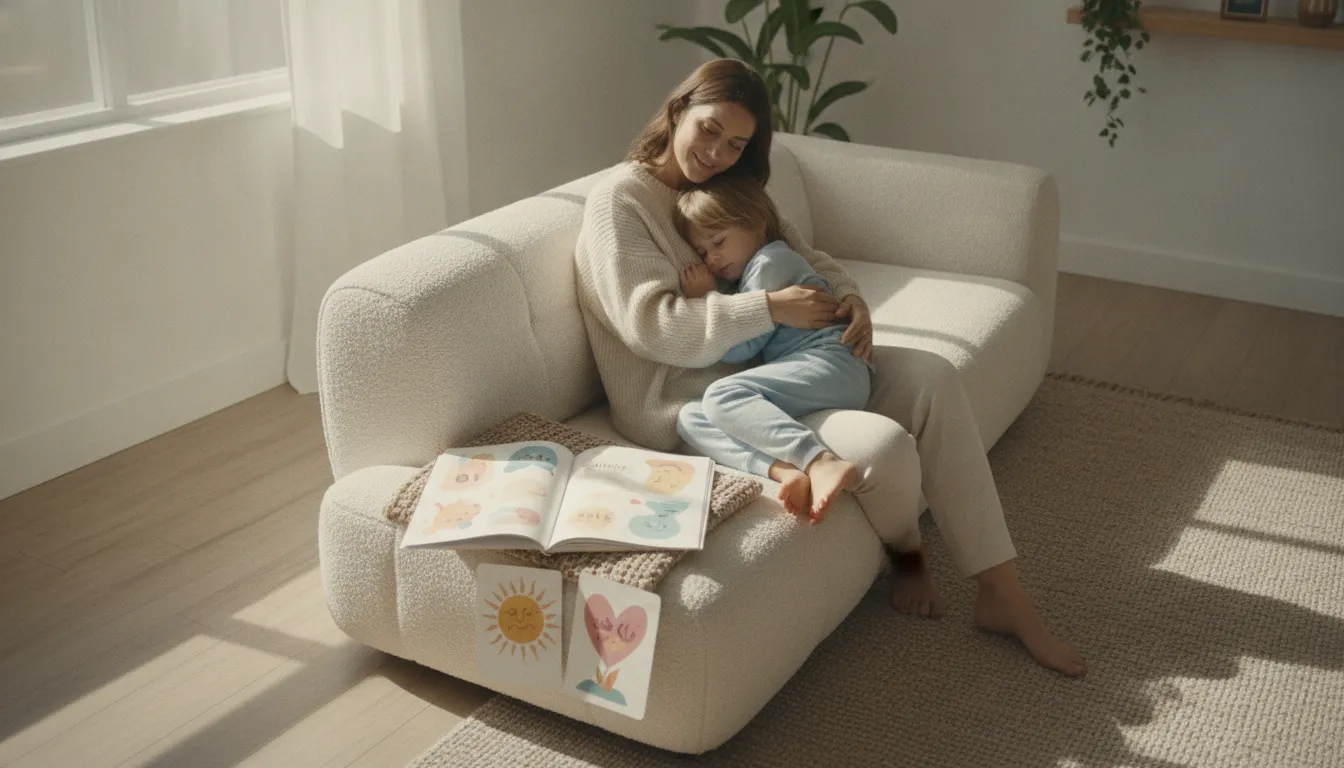
Creating emotionally safe spaces for children is one of the most profound gestures of care we can offer. It doesn’t need to be perfect—it needs to be genuine. Every imperfect conversation, every attempt to name an emotion, every hug offered at the right moment leaves positive marks on child development.
Remember: you don’t need to have all the answers. Sometimes, the most powerful phrase is simply: “Tell me. I’m here.”
This content is informative and educational and does not replace the evaluation, diagnosis, or treatment of a health professional. If you have questions or concerns about a child’s emotional health, consult a psychologist, pediatrician, or other qualified professional.