

Why is it so difficult for children to talk about what they feel?
Imagine a child who comes home from school quietly, drops their backpack on the floor and goes straight to their room. You ask “are you okay?” and hear a monosyllabic “yeah.” Or, at the opposite extreme, a child who bursts into tears or a tantrum without being able to explain why. Both situations are more common than they seem — and both have something in common: the difficulty of putting into words what happens inside.
This is not a character flaw or stubbornness. The child’s brain is still in full development. The areas responsible for identifying, naming and regulating emotions — such as the prefrontal cortex — continue to mature throughout childhood and adolescence. Studies in neurodevelopment indicate that this process extends into early adulthood. That is, when a child “explodes” or shuts down, they are not being difficult on purpose: they are doing the best they can with the tools they have.
The good news is that these tools can be expanded — and the adults around children play a fundamental role in this. Creating space for emotional conversation is one of the most important practices that families and caregivers can cultivate, and the benefits usually appear not only in childhood, but throughout life. In this article, we explore how to do this in a practical, welcoming and evidence-based way.
What is emotional intelligence in childhood (and why it matters)
Emotional intelligence can be understood, in simple terms, as the ability to recognize, understand and manage one’s own emotions — and also to perceive and respond to the emotions of others. This concept was widely discussed by researchers like Peter Salovey and John Mayer since the 1990s, and since then has accumulated a solid body of research.
In practice, children with greater emotional ability tend to:
- Better manage frustration and conflict
- Develop healthier relationships with peers and adults
- Show greater resilience in the face of school and social challenges
- Demonstrate fewer externalizing behaviors (such as aggression) and internalizing behaviors (such as anxiety and withdrawal)
It is important to be clear: emotional intelligence is not a fixed trait that you are born with or without. It develops, and the family and school environment plays a central role in this process. Research in developmental psychology suggests that children whose caregivers talk about emotions openly and without judgment tend to develop better emotional repertoire over time.
Emotional vocabulary: the first step to naming what you feel
Before a child can talk about what they feel, they need to have words for it. It seems simple, but it is a step that we often skip. “You are sad” or “you are angry” already help — but emotional life is richer and more nuanced than that.
Some adults know fewer than ten words for emotions. Expanding this vocabulary — for the child and for yourself — can transform the quality of conversations.
How to help build this vocabulary
- Name emotions in everyday life, not just during crises. “You felt proud when you finished the drawing, didn’t you?” or “It seems like you were excited before the trip.”
- Use books, movies and stories as bridges. Asking “What do you think the character is feeling here?” removes the pressure on the child to talk directly about themselves.
- Introduce emotions beyond the basics. Jealousy, boredom, pride, shame, relief, nostalgia — each new word is one more tool for self-understanding.
- Use visual resources if necessary. For younger children or those with verbal communication difficulties, cards with facial expressions or “emotion wheels” can be powerful allies.
- Model it yourself. Saying “I am feeling a bit overwhelmed today” normalizes that everyone has emotions — and that they can be spoken aloud.
Creating space: what does this mean in practice
“Creating space” for emotional conversation is not just saying “you can talk to me.” It is about real availability — physical, emotional and unhurried — and about the quality of how you listen.
Some attitudes that often help:
- Avoid closed-ended questions at the wrong time. “How was school?” when arriving home, with the child still decompressing, rarely generates a rich conversation. Sometimes the right moment is during dinner, before bed, or on a side-by-side walk.
- Don’t solve before listening. When a child tells you a problem, the instinct is to offer a solution. But often they need to be heard first. A simple “that sounds like it was difficult for you” can open up much more than “you should have done it this way.”
- Tolerate silence. Children sometimes need time to organize what they feel. Silence is not a conversation failure.
- Be truly present. Research in family psychology shows that the quality of attention matters more than the quantity of time. Phone away, eyes on the child — this communicates “you matter.”
- Don’t minimize. Phrases like “that’s nothing” or “stop being dramatic” — even said with good intention — teach the child that their emotions are not valid. Over time, they simply stop sharing them.
How to talk about difficult emotions: anger, sadness and fear
Some emotions are more challenging to embrace, especially when they appear intensely. Anger, deep sadness and persistent fears require a somewhat more careful approach.
Anger
Anger is a legitimate and healthy emotion — the problem lies in how it is expressed. Help the child identify what is behind it (“you got angry because you felt wronged?”) and validate the feeling before talking about the behavior.
Sadness
Sadness is not weakness. Allowing the child to cry, to be quiet, to process in their own time usually works better than trying to “cheer them up” immediately. Being alongside without demanding that the child feel better quickly is a powerful form of care.
Fear
Fears in childhood are very common and are part of development. Validating the fear (“I understand that scares you”) without reinforcing it excessively or dismissing it is the balance that usually helps. If fears are very intense or limiting, it is important to seek professional guidance.
The role of caregiver self-care in this equation
It is very difficult to create emotional space for a child when the adult themselves is overwhelmed, anxious or emotionally exhausted. This is not criticism — it is recognition of a very common reality.
Taking care of your own emotional health is part of being a present caregiver. This may include seeking psychological support, talking with trusted people, practicing some form of self-care that works for you. Practices such as mindfulness for beginners or the habit of writing about your own feelings — as explored in the article on personal journaling — can help adults also expand their own emotional repertoire.
Remember: you don’t need to be perfect to be a good caregiver. Making mistakes, apologizing and repairing the relationship are also powerful emotional lessons for the child.
When to seek professional help
Although the strategies described here are useful in everyday life, there are situations where the support of a specialized professional is essential. Consider seeking help from a child psychologist, pediatrician or other qualified health professional if you notice:
- Sudden and persistent changes in the child’s behavior or mood
- Emotional difficulties that are affecting sleep, eating, school performance or relationships
- Fears or anxieties that seem paralyzing or unusual for the age group
- Self-harm behaviors or statements that concern you about the child’s safety
- Intense and prolonged sadness with no apparent cause
- Any sign that causes concern — including the intuition that “something is not right”
If the child or someone around you is experiencing intense suffering or is in crisis, help is available. In Brazil, CVV (Center for Life Appreciation) responds to the number 188, with free calls, 24 hours a day. In emergency situations, go immediately to an emergency room or call SAMU (192).
Seeking professional help is not a sign of weakness or failure as a caregiver — it is an act of care and love.
Conclusion: small conversations that build great foundations
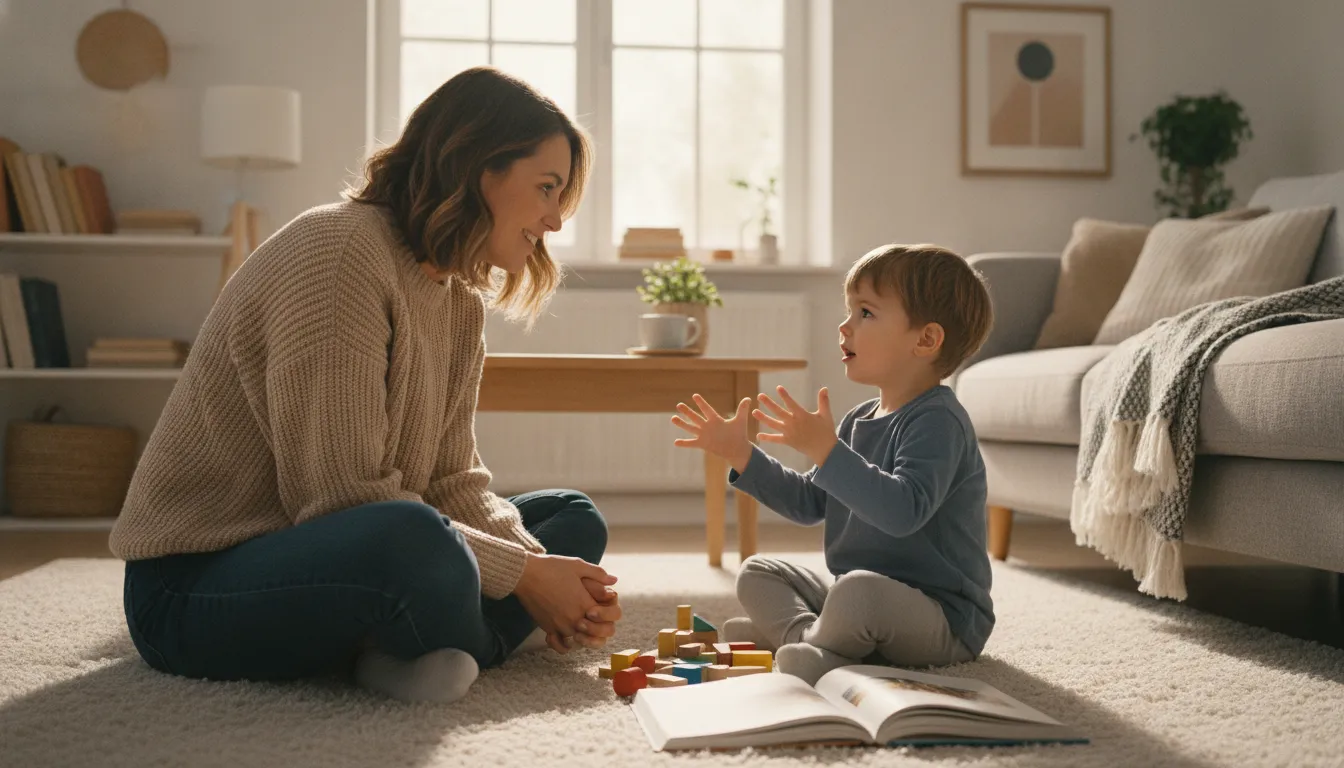
Creating space for children’s emotions does not require perfect techniques or ready-made answers. Above all, it requires presence, willingness and the genuine belief that what a child feels deserves to be taken seriously.
Each time you sit beside a child and ask “how are you really?”, each time you tolerate a cry without rushing its end, each time you name an emotion with care — you are building something they will carry for life: the certainty that their feelings have value, and that talking about them is safe.
It’s not about getting everything right. It is about continuing to try, with affection.
This content is exclusively informative and educational in nature, and does not replace the evaluation, diagnosis or treatment by a qualified health professional. Each child is unique, and for specific questions about physical or mental health, always consult a pediatrician, psychologist or other specialist you trust.