
# 5 Daily Practices to Achieve Mental Balance and Transform Your Life
In an increasingly fast-paced world filled with constant demands, maintaining mental balance has become one of the greatest contemporary challenges. The pursuit of psychological well-being is not just a luxury but a fundamental necessity for a full and meaningful life. Mental balance does not mean the absence of problems or challenges, but rather the ability to navigate them with resilience, clarity, and serenity.
The good news is that achieving and maintaining this balance is within reach for all of us through simple yet powerful practices that can be incorporated into our daily routine. These practices do not require hours of your day or significant financial investments—just commitment, consistency, and a genuine desire to prioritize your mental health.
In this article, we will explore five fundamental daily practices that have the power to profoundly transform your relationship with yourself, others, and life. These strategies are supported by both science and ancient wellness traditions, and when applied consistently, can create lasting changes in your quality of life. Get ready to embark on a journey of transformative self-discovery that will set you on the path to sustainable mental balance.
1. Morning Meditation: Starting the Day with Mental Clarity
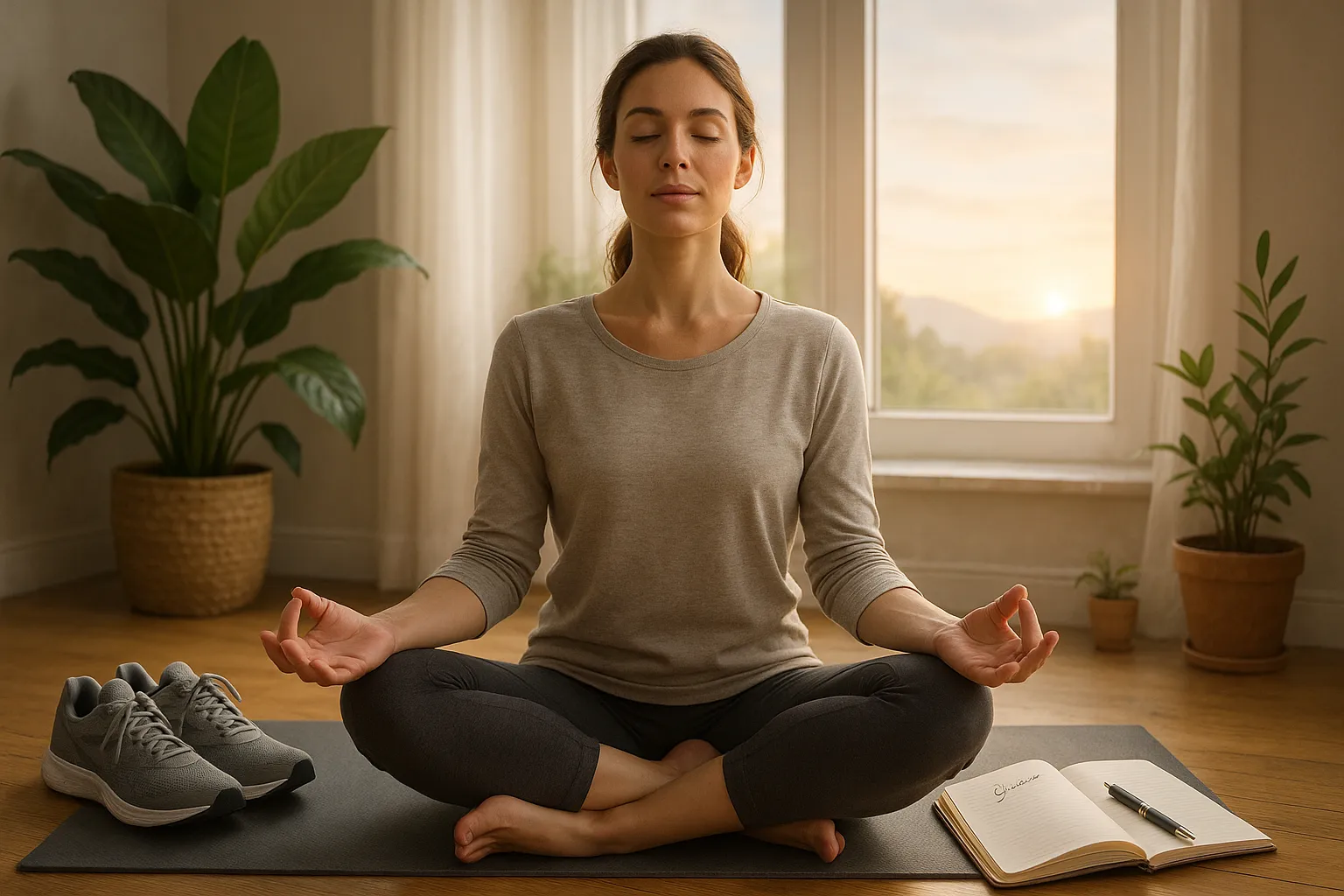
Morning meditation is undoubtedly one of the most transformative practices you can adopt to cultivate mental balance. Dedicating the first few minutes of the day to quieting the mind and centering on the present moment sets a tone of serenity that reverberates through all your subsequent activities.
Scientific studies, including research published by the American Psychological Association, show that regular meditation significantly reduces cortisol levels (the stress hormone), improves concentration, increases emotional awareness, and promotes positive structural changes in the brain.
To start, you don’t need to meditate for long periods. Begin with just 5 to 10 minutes in the morning, before checking your phone or diving into the day’s tasks. Find a quiet place, sit comfortably with your spine straight, close your eyes, and focus on your breathing. Notice the air entering and leaving your nostrils, the expansion and contraction of your abdomen. When thoughts arise—and they will—simply acknowledge them without judgment and gently redirect your attention to your breath.
There are various meditation techniques you can explore: mindfulness meditation, guided meditation, transcendental meditation, or simply the practice of breath observation. Apps like Headspace, Calm, or Lojong offer excellent resources for beginners.
The key to reaping the benefits of meditation is consistency. Even on the busiest days, reserve these precious minutes for yourself. Over time, you will notice greater mental clarity, reduced anxiety, better emotional regulation, and a deep sense of inner peace that remains even in the face of daily challenges.
2. Gratitude Practice: Transforming Perspectives and Cultivating Positivity
Gratitude is much more than simply saying “thank you”—it is an intentional practice of recognizing and appreciating the positive aspects of life, even amid difficulties. Research in positive psychology, conducted by experts like Harvard Health, reveals that regularly cultivating gratitude is associated with higher levels of happiness, more satisfying relationships, better physical health, and greater resilience in the face of adversity.
Incorporating the practice of gratitude into your daily routine is surprisingly simple. One of the most effective ways is to keep a gratitude journal. Each morning or before bed, write down three to five things you are grateful for that day. These can be major achievements or small moments: a meaningful conversation, a delicious meal, a ray of sunshine through the window, the health of a loved one, or simply the fact that you have a roof over your head.
The power of this practice lies in its ability to reorient your attention. Our brain has a natural bias to focus on negativity—a survival mechanism. The deliberate practice of gratitude counterbalances this tendency, training our mind to recognize and value the positive.
Besides the journal, you can practice gratitude in other ways: expressing appreciation directly to people in your life, taking a pause during the day to mentally list things you are grateful for, or creating family rituals where everyone shares their gratitudes. These practices not only improve your own well-being but also strengthen your relationships and create a more positive environment around you.
Over time, gratitude ceases to be just a practice and becomes a lens through which you see the world—a perspective that recognizes abundance instead of scarcity, possibilities instead of limitations. Just like those who practice the secrets of truly happy people, gratitude becomes second nature.
3. Conscious Physical Movement: Connecting Body and Mind
The connection between physical health and mental balance is undeniable and deeply intertwined. Regular physical movement is not only beneficial for your body but is essential for your mental health. When we move, our brain releases endorphins, serotonin, and dopamine—neurotransmitters that naturally elevate mood, reduce anxiety, and promote feelings of well-being.
The concept of “conscious movement” goes beyond simple physical exercise. It involves moving with intention and presence, connecting with your body and the sensations it experiences. This can include yoga, contemplative walks, dance, tai chi, mindful stretching, or any form of physical activity practiced with mindfulness.
Studies by the World Health Organization recommend at least 150 minutes of moderate physical activity per week for adults, but even smaller amounts can have significant impacts on mental balance. The important thing is to find forms of movement that you genuinely enjoy, making the practice sustainable in the long term.
A 20-minute morning walk can be transformative. Use this time to observe the nature around you, feel the air on your face, the rhythm of your steps, the sensation of your feet touching the ground. Leave your phone on silent mode and allow yourself to be present in this experience.
Yoga, in particular, offers a perfect synthesis between physical movement and mental practice. Through postures (asanas), breathing techniques (pranayama), and moments of stillness, yoga simultaneously cultivates strength, flexibility, body awareness, and mental equanimity.
Conscious movement also serves as a healthy outlet for accumulated stress. When we face emotional tensions, our body often retains this energy. Movement allows us to release this tension constructively, preventing it from manifesting as chronic anxiety or other health problems.
Remember: it’s not about perfection or achieving ambitious athletic goals. It’s about honoring your body, celebrating what it can do, and using movement as a bridge to greater self-awareness and mental well-being.
4. Intentional Digital Detox: Reclaiming Your Attention and Presence
We live in an era of digital hyperconnectivity that, paradoxically, can leave us more disconnected from ourselves and the people around us. The constant bombardment of notifications, social media updates, and digital demands fragments our attention, elevates our stress levels, and significantly compromises our mental balance.
The practice of intentional digital detox does not mean completely abandoning technology, but rather establishing healthy boundaries and creating spaces in your day free from the influence of screens and digital devices. Research shows that excessive use of social media is correlated with increased levels of anxiety, depression, and negative social comparison.
Start by establishing specific periods of “digital detox” in your daily routine. Some practical suggestions include:
– **No screens during the first hour after waking up**: Instead of immediately checking emails or social media, use this time for your morning practices of meditation, gratitude, or exercise.
– **Tech-free zone during meals**: Eat mindfully, savoring your food, and if accompanied, engaging in genuine conversations.
– **No screens one hour before bed**: The blue light emitted by digital devices interferes with melatonin production, compromising sleep quality. Use this time to read, converse, or practice relaxation.
– **A weekly day of disconnection**: Consider choosing a day (or part of it) for a more complete digital disconnection, reconnecting with analog activities and presence in the physical world.
These intentional breaks allow your mind to rest, processing experiences and emotions without constant distraction. You will notice greater mental clarity, better sleep quality, deeper relationships, and a renewed appreciation for the simple moments of life.
Digital detox also creates space for activities that genuinely nurture your mental balance: reading, creative hobbies, time in nature, meaningful conversations. These are the experiences that, when we look back, truly enrich our lives.
5. Evening Reflection and Preparation for Restorative Sleep

The quality of your sleep has a direct impact