Pilates and Its Benefits for Body and Posture
Do you ever finish a workday feeling that familiar tension in your neck, shoulders, or back? Or perhaps you’ve noticed in the mirror that your posture isn’t quite what it used to be a few years ago? These sensations are more common than they seem — and in an increasingly sedentary, digitally connected world, caring for your body consciously has become a real necessity for many people. It’s in this context that Pilates has gained growing recognition as an integrative and accessible movement practice.
Developed in the early 20th century by German Joseph Pilates, the method was born with the name “Contrology” — a reference to conscious control of the body through movement. Since then, it has undergone decades of evolution, adaptation, and scientific research, arriving in 2026 as one of the most studied and recommended exercise practices by physiotherapists, fitness educators, and health professionals worldwide. And for good reason: its principles of breathing, alignment, concentration, and coordinated movement touch on something many of us have lost in our daily lives — the connection with our own body.
This article brings together evidence-based information to help you understand what Pilates is, how it can benefit your body and posture, and how to safely consider including it in your routine. It does not replace the assessment of a health professional, but can be a starting point for more informed decisions about your well-being.
What Is the Pilates Method?
Pilates is a system of exercises that works the body globally, with emphasis on what the methodology calls the “powerhouse” or “center of force” — the region formed by the abdominal, lower back, hip, and gluteal muscles. The central idea is that a stable and strong core supports all body movements more efficiently and healthily.
The practice can be performed in two main formats:
- Solo (mat Pilates): exercises performed on the ground, on a mat, using your own body weight and possibly small accessories such as balls, elastic bands, and resistance circles.
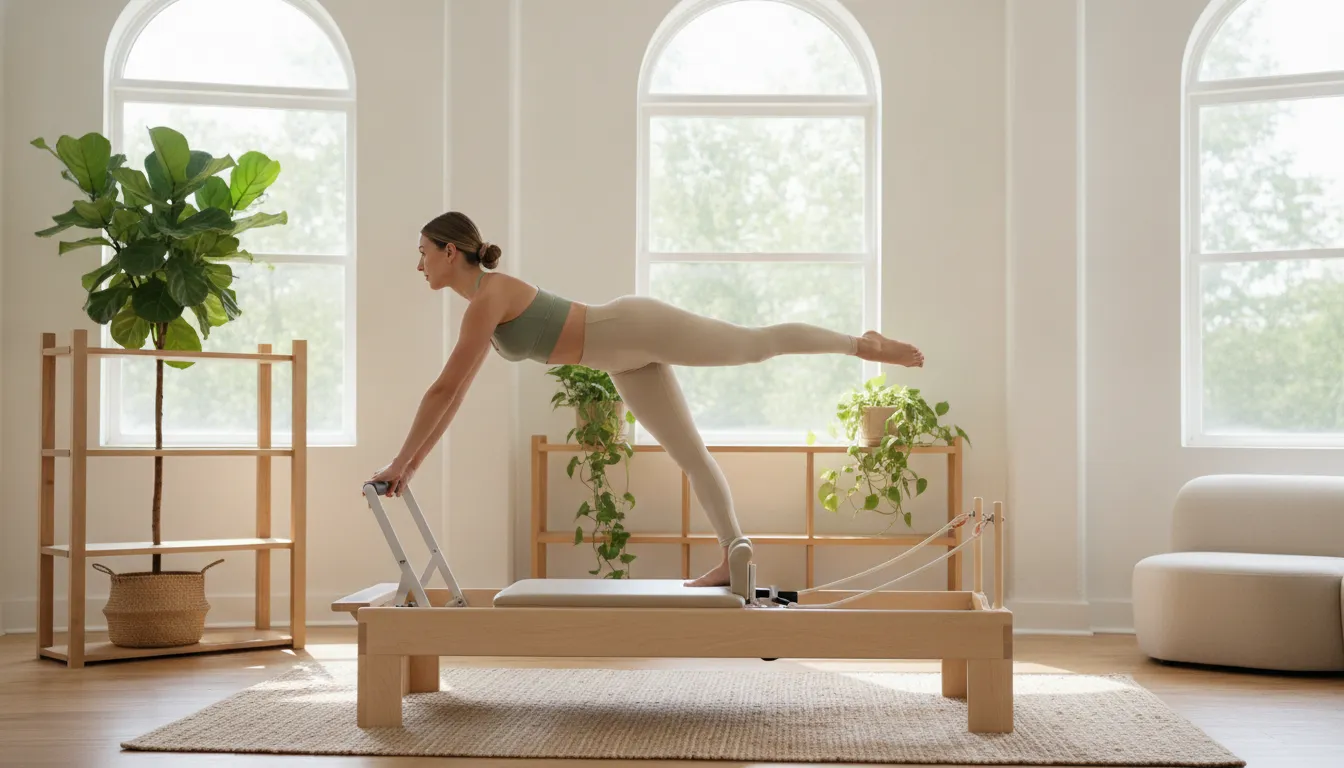
- On apparatus: such as the Reformer, Cadillac, Chair, and other equipment developed by Joseph Pilates himself, which use springs to provide adjustable resistance, allowing adaptations for different fitness levels and physical conditions.
The fundamental principles of the methodology include:
- Centering
- Concentration
- Control
- Precision
- Flow
- Breathing
These principles make Pilates a practice that requires mental presence — which, as we’ll see, also brings benefits that go beyond the physical.
Pilates and Posture Improvement: What Does Research Say?
One of the most cited reasons to start Pilates is posture — and there are good reasons for this. Studies published in journals such as the Journal of Bodywork and Movement Therapies and the Archives of Physical Medicine and Rehabilitation suggest that regular Pilates practice can contribute to strengthening deep postural muscles, improving spinal alignment, and reducing muscular imbalances.
Poor posture rarely has a single cause. It usually results from a combination of factors: long hours sitting, excessive use of digital devices, muscle weakness, repetitive movement patterns, and even emotional issues. Pilates works on several of these points simultaneously by:
- Strengthening stabilizer muscles of the spine (such as multifidus and transverse abdominis)
- Stretching muscle groups that are frequently shortened, such as chest, hip flexors, and hamstrings
- Body awareness — the perception of how you position your body in space, called proprioception
It’s important to say honestly: most available studies are of good quality, but with still limited sample sizes. Science suggests real benefits, but results vary from person to person. Talking with a health professional or specialized fitness educator is essential to understand what the method can offer for your specific case.
If you’re also concerned about posture at work, you might be interested in the article Improve posture at work: where to start, which offers practical and complementary tips.
Other Benefits for the Body
Beyond posture, scientific literature and clinical practice indicate that Pilates can contribute to:
Flexibility and Joint Mobility
The method includes movements in ranges that many people don’t use in their daily lives, which can help maintain or recover joint flexibility and overall mobility.
Functional Strength
Unlike training focused on muscle growth, Pilates works strength in an integrated way — muscles working together in movement patterns that reflect daily activities, such as carrying weight, climbing stairs, or getting up from the floor.
Balance and Coordination
Exercises that challenge balance are frequent in the methodology, and studies suggest that this can be especially beneficial for older adults, contributing to fall prevention.
Support for Musculoskeletal Pain
Several studies have investigated the effect of Pilates on people with chronic lower back pain. Results tend to be positive regarding pain intensity reduction and functional improvement — though it’s always worth reinforcing that Pilates is not a medical treatment and should be part of a care plan guided by professionals.
Breathing
The emphasis on conscious breathing during exercises can help improve breathing mechanics and promote a greater sense of control and calm.
Pilates and Mental Health: A Real Connection
The relationship between movement and mental health is well established in scientific literature. In the case of Pilates, the mindful and concentrated nature of exercises — which requires presence in the moment — can bring benefits that go beyond physical body.
People who practice Pilates frequently report feelings of well-being, reduced tension, and greater body awareness. While these reports cannot be generalized as guaranteed results, the connection between regular physical activity, mental health, and quality of life is widely recognized by organizations such as the World Health Organization (WHO).
If you feel that stress or burnout are affecting your relationship with your own body and self-care habits, it might be helpful to read about how to identify burnout in your daily life — and remember that caring for mind and body tend to go hand in hand.
How to Get Started: A Practical Guide for Beginners
If you’re thinking about trying Pilates, here are some general guidelines to take your first steps safely:
- Consult a health professional before starting. Especially if you have preexisting health conditions, chronic pain, history of injuries, or are pregnant. A doctor, physiotherapist, or fitness educator can indicate the most suitable format for you.
- Choose an environment with a qualified professional. Look for instructors with certified training in Pilates. In Brazil, the practice can be conducted by physiotherapists and fitness educators, each with complementary approaches.
- Start slowly and respect your body. Pilates values movement quality over quantity. There’s no need to “force” — progress happens gradually.
- Be consistent. Like any movement practice, benefits tend to appear with regularity over time — not immediately or guaranteed.
- Communicate discomfort to your instructor. Pain during exercise is not normal and should be reported immediately. The professional can adapt the movements.
- Integrate Pilates with other healthy habits. Quality sleep, balanced nutrition, and emotional care form a whole. No isolated practice works miracles — but good choices combined make a difference. Learn more at healthy habits: how to create and maintain with consistency.
Pilates for Different Audiences
One of the great advantages of the method is its adaptability. With proper adjustments, Pilates can be practiced by people at different life stages and conditions:
| Audience | Possible Adaptations |
|---|---|
| Beginners | Basic floor exercises, gradual progression |
| Older Adults | Focus on balance, mobility, and functional strengthening |
| People in Rehabilitation | Conducted by a physiotherapist, with therapeutic focus |
| Pregnant Women | Requires specialized guidance and specific adaptations |
| Advanced Practitioners | Use of apparatus and greater movement complexity |
Regardless of profile, individual assessment by a professional is always the safest starting point.
When to Consult a Health Professional
Pilates is generally considered a safe practice — but there are situations where professional guidance is especially important before starting or continuing:
- Back, neck, or joint pain that persists or worsens
- History of musculoskeletal injuries, surgeries, or fractures
- Conditions such as osteoporosis, herniated disc, scoliosis, or cardiovascular diseases
- Recent pregnancy or postpartum
- Any doubt about whether exercise is appropriate for your current condition
In these cases, a doctor, physiotherapist, or fitness educator can indicate the safest and most effective format for you — and, if necessary, adapt or contraindicate certain exercises.
Conclusion
Pilates is not a magic solution, but it is a practice with solid foundations and growing scientific support. For many people, it can be a gentle and effective way to reconnect with your own body, care for posture, strengthen muscles, and find a moment of mindfulness amid the rush of daily life.
If you’re unsure about where to start, remember: taking the first step with proper information and guidance is already a form of self-care. Your body deserves attention — and you deserve to feel good in it.
This content is informative and educational, and does not replace the assessment, diagnosis, or treatment of a health professional. Always consult a doctor, physiotherapist, or fitness educator before starting any exercise practice, especially if you have preexisting health conditions.