
How to Talk to Children About Emotions
Imagine a child coming home from school quietly, dropping their backpack on the floor, and heading straight to their room without a word. You ask, “What’s wrong?” and they reply, “Nothing” — and the silence lingers. This scene is familiar to many parents, guardians, and caregivers. Often, what’s behind that “nothing” is something the child doesn’t yet have words to express.
Talking about emotions with children is not a luxury or a passing trend. It is a skill that significantly contributes to their healthy development. Developmental psychology studies suggest that children who learn to identify and express their feelings tend to develop better emotional regulation, social skills, and resilience throughout life. In 2026, with an increasingly fast-paced world and children exposed to intense stimuli from a young age, this conversation has become even more necessary.
The good news is you don’t need to be a psychologist to start. This article provides evidence-based guidance to help parents, grandparents, teachers, and caregivers open this dialogue in a welcoming, honest, and developmentally appropriate way.
Why Talking About Emotions Matters So Much
Emotional intelligence — understood as the ability to recognize, understand, and manage one’s own emotions and those of others — begins to develop in the early years of life. Just like learning to read or ride a bike, it requires practice and teaching.
When adults name emotions and demonstrate how to deal with them, they teach by example. The Pan American Health Organization (PAHO) highlights that welcoming and emotionally safe family environments are important protective factors for children’s mental health. This doesn’t mean the family needs to be perfect — it means there is space to feel, talk, and be heard.
Moreover, children who do not learn to name what they feel may express their emotions in other ways: through challenging behaviors, physical complaints like stomachaches and headaches, isolation, or excessive irritability. Recognizing these signs as possible emotional expressions is the first step in opening a communication channel.
Understanding Emotional Development by Age Group
There is no one-size-fits-all formula because the emotional vocabulary of a 3-year-old is very different from that of a 10-year-old. Adapting the conversation to the developmental stage is crucial.
Babies and Children Up to 3 Years
At this stage, the baby doesn’t have verbal language for emotions but already feels and responds. What caregivers do here is mirror: “You’re angry because you don’t want to stop playing, I understand.” Naming what the child seems to feel, even without them asking, plants the seeds of emotional vocabulary.
Children Aged 3 to 6 Years
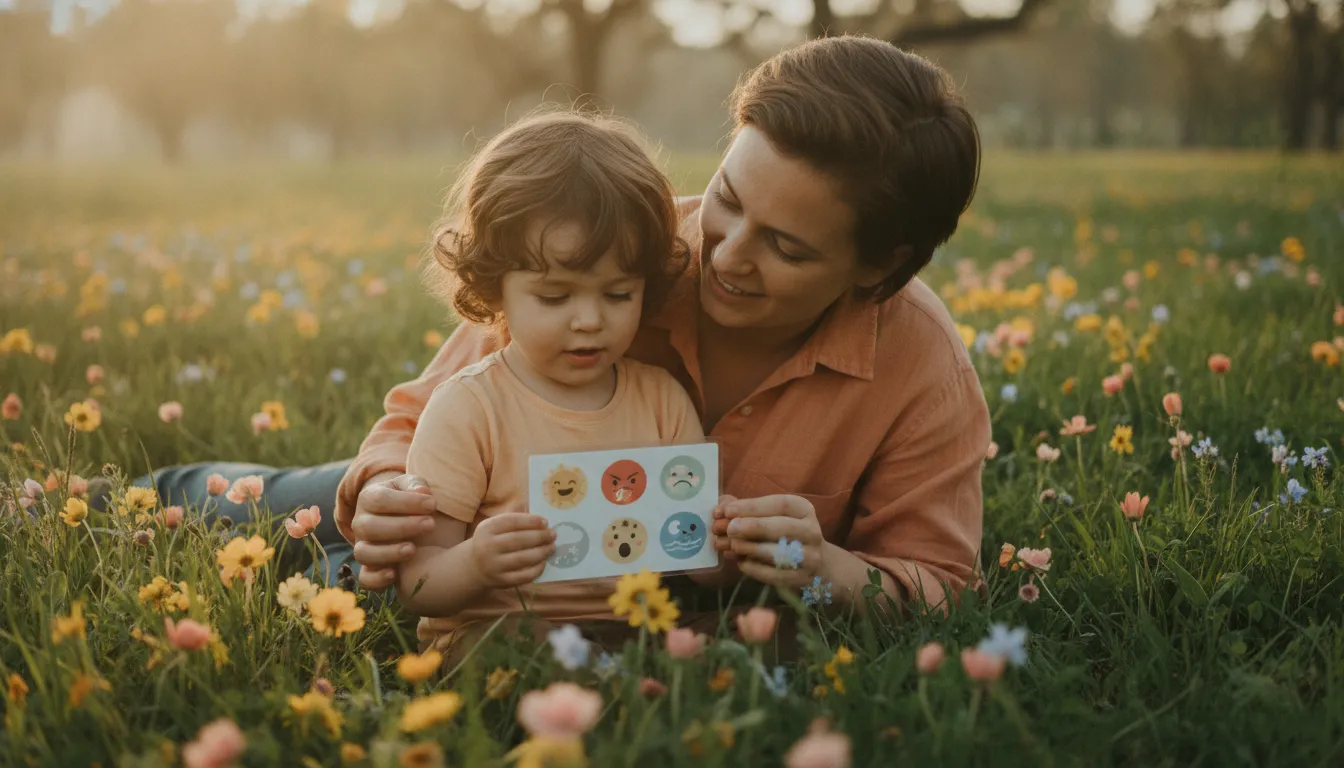
The child starts using words, but their repertoire is small — usually “happy,” “sad,” “angry,” and “afraid.” Visual tools like the emotion wheel or story characters are powerful allies. Simple questions like “how is your little heart feeling now?” work very well.
Children Aged 7 to 12 Years
Reasoning is more developed. It’s possible to have deeper conversations: “What did you feel when that happened?” or “What do you think made you feel that way?” Validating without minimizing (“that really hurts”) is essential at this stage.
Teenagers
Conversations with teenagers require more patience and less haste. They tend to shut down when they feel interrogated. Lateral approaches — during a walk, a car ride, or watching a series together — often work better than a “formal” face-to-face conversation.
How to Create a Safe Environment for Emotions
Before any technique or strategy, what a child needs is to know that their feelings won’t scare or irritate the adult. This is called emotional safety, and it is built in the small interactions of everyday life.
Some practices that usually help:
- Don’t judge the emotion. “There’s no reason to be afraid of that” or “stop crying over nothing” teach that certain emotions are wrong or shameful.
- Validate before solving. Before offering solutions, acknowledge the feeling: “It makes sense you’re frustrated. That was really hard.”
- Show your own emotions. When adults say “I’m feeling overwhelmed today and need a quiet moment,” they teach that feeling and naming is natural and healthy.
- Avoid the immediate “but”. “I understand you’re sad, but it could be worse” invalidates what the child feels before they even feel heard.
Practical Tools to Start the Conversation
Sometimes, the biggest obstacle is simply not knowing how to broach the subject. Here are some strategies that child psychology professionals often recommend:
- Use stories and characters. Children’s books with emotional themes are incredible bridges. Asking “how do you think the character felt here?” is an indirect and safe way to explore feelings.
- Emotion thermometer. Ask the child to rate how they’re feeling from 1 to 10. This turns something abstract into something concrete.
- The “high, low, and curious” technique. At dinner or before bed, each family member shares the best moment of the day, the hardest, and something they found interesting. This normalizes talking about what was good and what was bad.
- Draw what you feel. For younger children, or even for those more introverted, putting the emotion on paper may be easier than speaking.
- Emotional card games. There are educational games developed by psychologists specifically to stimulate emotional vocabulary in a playful, pressure-free way.
- Open-ended questions at the right time. Instead of “are you okay?”, try “what was the hardest part today?” or “was there a moment you didn’t like?”
Caring for emotional health from an early age also involves other pillars of well-being. If you want to understand more about how to start prioritizing emotional health in the family, the article Caring for Emotional Health: Where to Start can be a useful complement.
The Role of Sleep in Children’s Emotional Regulation
One detail that many families don’t directly connect: children who don’t sleep well have much more difficulty regulating their emotions. Studies in the field of sleep and neurodevelopment suggest that sleep deprivation in children is associated with increased irritability, lower frustration tolerance, and concentration difficulties.
This means ensuring quality sleep appropriate for the age group is also part of emotional care. You can learn more about this in the article How Much Sleep Do You Need at Each Stage of Life?.
Common Mistakes and How to Avoid Them
Even with the best intentions, some patterns can hinder emotional communication with children:
- Comparing feelings. “Your brother doesn’t do that” or “in my day, kids didn’t complain” usually generates shame, not learning.
- Resolving too quickly. The rush to remove the child’s discomfort can teach that difficult emotions are a problem to be eliminated, not an experience to be traversed.
- Inconsistency. If one day the adult welcomes crying and another punishes it, the child learns it’s not safe to feel — because the response is unpredictable.
- Ignoring one’s own emotions. Children are extremely sensitive to the emotional state of the adults around them. An adult who takes care of their own emotional health is, in itself, a powerful model.
When to Seek a Health Professional
Some situations indicate that it may be important to seek the support of a child psychologist or other mental health professional:
- The child shows intense and persistent sadness, anxiety, or irritability for weeks
- There is a regression in behavior (an older child reverting to younger behaviors) without an apparent cause
- Frequent school refusal accompanied by distress
- Recurring physical complaints without an identified medical cause (stomachaches, headaches)
- The child talks about not wanting to exist or expresses thoughts that worry caregivers
In these cases, don’t wait to seek professional guidance. A child psychologist is the most suitable professional to assess and support both the child and the family. If there is a situation of intense suffering or crisis, remember that help exists: the CVV (Centro de Valorização da Vida) is available at 188, free of charge, 24 hours a day. In emergencies, seek medical attention immediately.
Conclusion
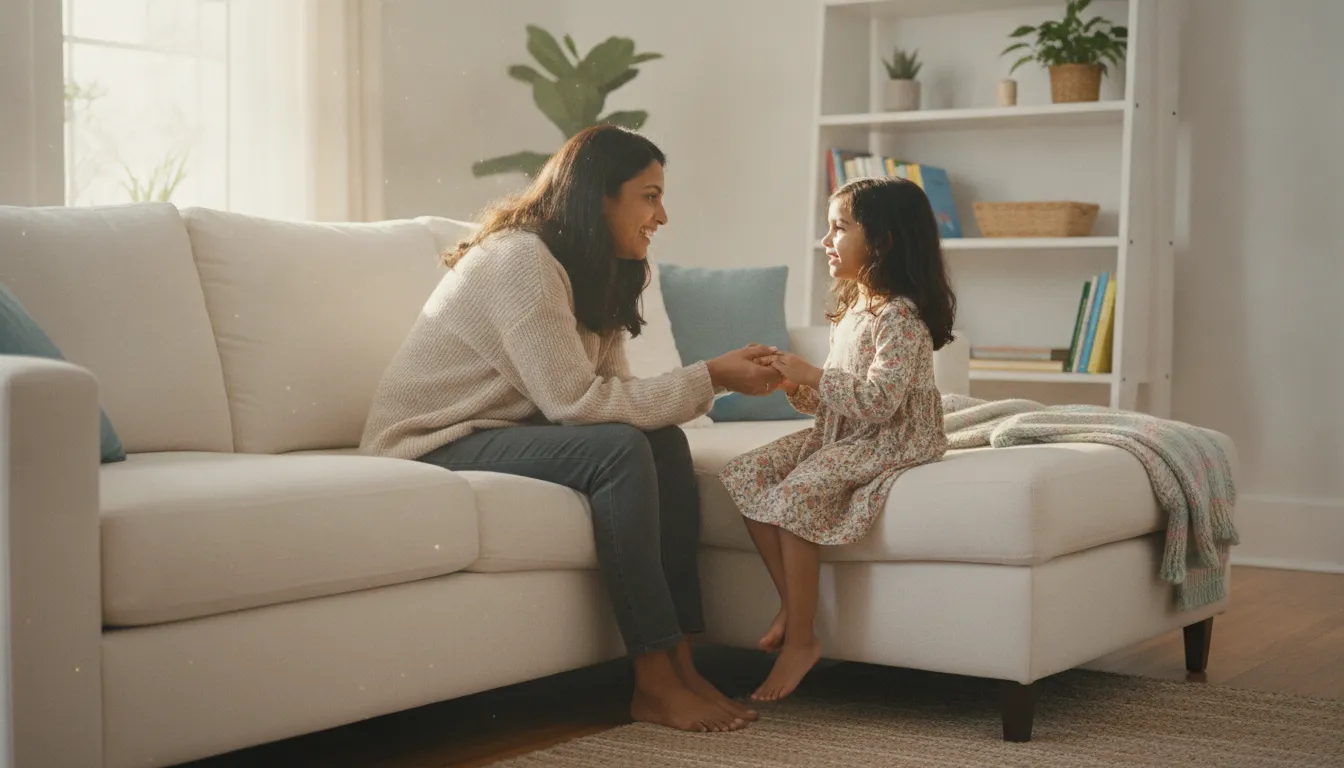
Talking about emotions with children doesn’t need to be a long, structured, or perfect conversation. It can be a five-minute moment before bed, a sentence while you prepare dinner, or simply being present when the child decides to open their little heart.
The most important thing is that they know their feelings have space, have a name, and won’t scare those they love. This, in itself, is already a huge gift.
And when you feel you need more than general guidance — whether to support your child or to care for your own emotional health as a caregiver — don’t hesitate to seek a professional. Asking for help is also a way of caring.
This content is informative and educational and does not replace the evaluation, diagnosis, or follow-up of a health professional. Every child is unique, and a psychologist or doctor can offer appropriate guidance for your family’s specific situation.