

Why Those Who Work Sitting Need to Pay Attention to Their Bodies
If you spend a good part of the day in front of a screen—whether in the office, at home, or in the hybrid model that has become established in recent years—you know well how the body signals discomfort over the hours: that neck tension, the heaviness in the back, the sensation of legs “falling asleep.” It’s not your imagination. Prolonged sedentary behavior is a topic increasingly studied by science, and findings indicate that sitting for long periods without interruption often brings real consequences for musculoskeletal, circulatory health, and even mental well-being.
The good news is that simple movements, done regularly throughout the day, can help counterbalance these effects. We’re not talking about turning the office into a gym or hours of intense training. We’re talking about accessible strategies, based on what scientific literature and health organizations recognize as beneficial for those with a predominantly seated routine.
This article gathers exercises and movement habits that often make a difference for this type of person. Remember, however, that each body is unique: before starting any exercise program, especially if you have pain, injuries, or pre-existing health conditions, it is ideal to talk to a doctor, physiotherapist, or physical educator.
What Happens to the Body When We Sit for Too Long
To understand why movement matters, it’s worth knowing what happens internally. When we remain seated for prolonged periods without breaks, some physiological processes are affected:
- Blood circulation: The flow in the lower limbs tends to slow down, which can contribute to a feeling of heaviness and swelling in the legs.
- Postural muscles: Muscles such as the glutes and core stabilizers are under-activated, while others—like the trapezius and cervical—become overloaded.
- Hip flexibility: Sitting for hours can shorten the iliopsoas muscle (hip flexor), which, over time, often negatively influences posture and causes lower back discomfort.
- Metabolism: Studies suggest an association between long periods of sitting and changes in metabolic markers, although it’s important to separate sedentary behavior from other lifestyle factors.
The World Health Organization (WHO), in its physical activity guidelines, highlights that reducing sedentary time and replacing it with any level of physical activity—even light—usually brings health benefits.
The Logic of Active Breaks: Small Pauses, Big Difference
Before discussing the exercises themselves, it’s important to understand the concept of active break: brief interruptions during the sitting period to perform simple movements. Research in the field of occupational health suggests that getting up and moving for a few minutes every hour can help reduce fatigue, improve circulation, and even contribute to focus and productivity—something we delve into more deeply in the article on focus and concentration: techniques to be more productive during the day.
A practical strategy is to use reminders on your phone or productivity apps to create the habit of taking breaks every 45 to 60 minutes. The important thing is not the exact duration but the consistency throughout the week.
Essential Exercises for Those Who Sit: What to Do and How
The following movements are generally recommended by physiotherapists and physical educators for people with a sedentary routine. They can be done in the work environment or at home, without special equipment. If any cause pain, stop immediately and consult a professional.
Cervical and Shoulder Mobility
The neck and shoulder region holds a lot of tension for those who work on the computer.
- Sit upright, feet flat on the floor.
- Slowly tilt your head to the right, as if trying to touch your ear to your shoulder. Hold for 20 to 30 seconds.
- Repeat on the left side.
- Perform slow and gentle shoulder rotations forward and backward—about 10 times in each direction.
- Interlace your fingers behind your head and gently open your elbows back, expanding your chest.
Hip Flexor Stretch
One of the most important for those who spend hours sitting.
- Standing, take a wide step forward with your right foot, as in a lunge position.
- Slowly lower your left knee toward the floor, keeping your torso upright.
- Push your hip slightly forward until you feel a gentle stretch in the front of your left thigh and hip.
- Hold for 20 to 30 seconds. Switch sides.
Glute and Core Activation
Muscles that tend to “fall asleep” with prolonged sedentarism.
- Glute Bridge: Lie on your back (can be done on a mat during lunch break), knees bent, feet flat. Slowly lift your hips, contracting your glutes. Hold for 3 to 5 seconds and lower. Repeat 10 to 15 times.
- Sitting Abdominal Isometric Contraction: Sitting in the chair, inhale and as you exhale, contract your abdomen as if trying to move your navel away from your pants. Hold for 5 to 10 seconds. Repeat 8 to 10 times.
Thoracic Mobility
The thoracic spine (region between neck and lower back) tends to become rigid with a hunched posture.
- Sit on the edge of the chair, spine straight.
- Cross your arms over your chest.
- Slowly rotate your torso to the right, without moving your hips. Hold for 3 to 5 seconds.
- Return to the center and repeat on the left side. Do 5 to 8 repetitions on each side.
Walking: The Most Underestimated Exercise
Don’t underestimate the power of simply walking. Walking around the room, taking stairs instead of the elevator, fetching water more often—all these add up to movement throughout the day. The WHO recommends that adults engage in at least 150 minutes of moderate-intensity physical activity per week, and walking counts.
Ergonomics: The Exercise Starts Before You Get Up
There’s no point in taking active breaks if your posture during work is harming your body. Some ergonomic points that often make a difference:
- Chair height: Feet should touch the floor, with knees at an angle close to 90 degrees.
- Monitor: The top of the screen should be at eye level, about 50 to 70 cm away.
- Keyboard and mouse: Elbows should remain close to the body, with the wrist in a neutral position.
- Lumbar support: The chair should support the natural curvature of the lower back. If not, a small cushion can help temporarily.
These are general guidelines. An ergonomist or physiotherapist can make an individualized assessment of your workstation.
Incorporating Movement as a Real Habit
Knowing the exercises is the first step. The bigger challenge is usually consistency. Some strategies that can help:
- Start small: Two active breaks a day are better than none. Gradually increase.
- Associate with something you already do: Stand up whenever you answer the phone, or do cervical stretches while waiting for the coffee to brew.
- Be kind to yourself: Days when the pace didn’t allow for even one break happen. The goal is the trend over time, not daily perfection.
For those who want to delve into strategies for creating healthy movement habits, the article How to Make Exercising a Lasting Habit offers a practical approach to the topic.
When to Seek a Health Professional
Active breaks and general exercises are important allies, but there are situations where professional guidance is indispensable. Seek a doctor, physiotherapist, or physical educator if you:
- Experience persistent pain in the spine, neck, shoulders, or limbs—especially if it radiates to the arms or legs.
- Notice tingling, numbness, or weakness in the limbs.
- Have a history of herniated disc, arthritis, osteoporosis or any diagnosed musculoskeletal condition.
- Feel pain that worsens with movement or does not improve after a few days of relative rest.
- Want to set up a personalized and safe exercise program for your reality.
These signs deserve evaluation—not because they are necessarily serious, but because a qualified professional can identify the cause and guide the best path for your specific case.
Conclusion: Your Body Thanks You for Every Movement
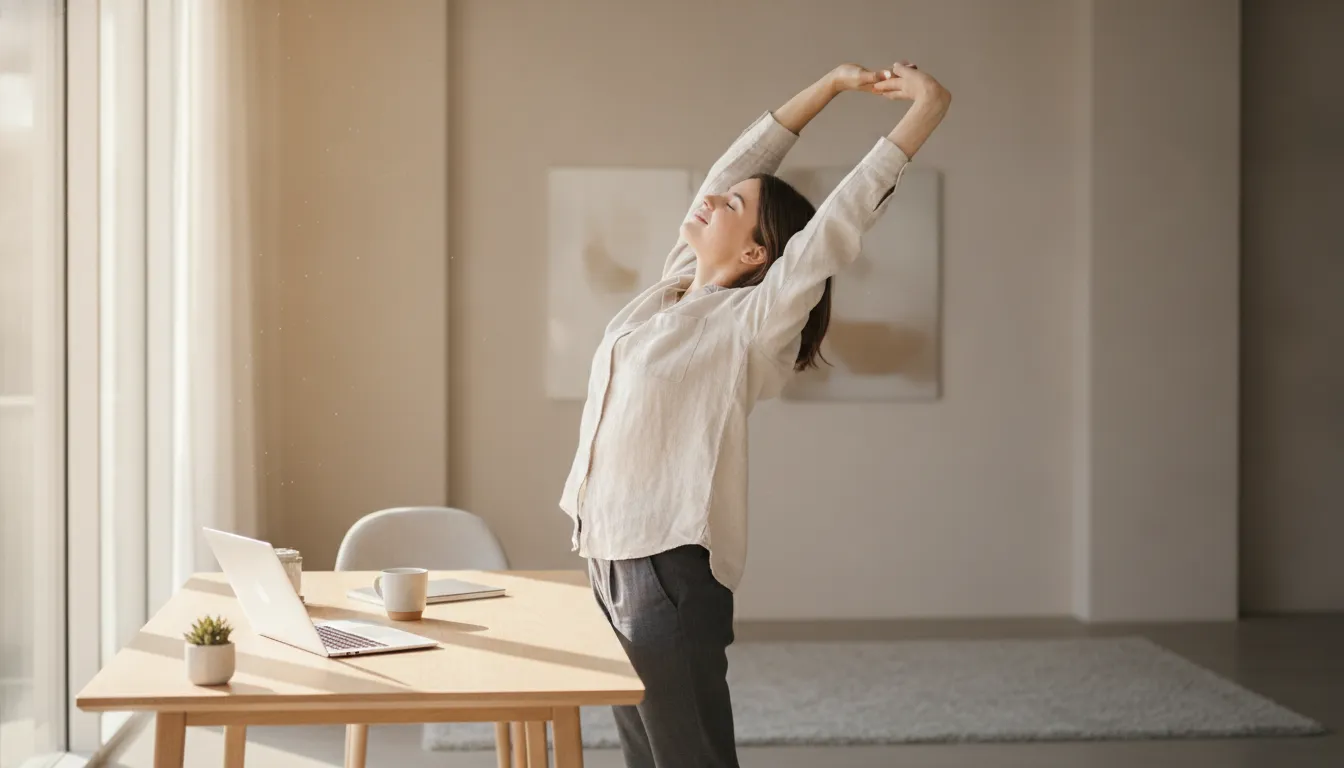
Working seated is a reality for millions of people, and there is nothing wrong with that. What makes a difference is what we do throughout the day to counterbalance the effects of this prolonged posture. Simple mobility exercises, strategic stretches, regular active breaks, and attention to ergonomics are accessible tools that, when practiced consistently, often contribute to more comfort, energy, and quality of life.
Start slowly, respect your body’s limits, and whenever you have doubts or feel something unusual, seek guidance from a health professional. Taking care of yourself doesn’t have to be complicated—sometimes, it just takes getting up from the chair.
This content is for informational and educational purposes only and does not replace the evaluation, diagnosis, or treatment by a qualified health professional. Each person has individual needs, and only a qualified professional can provide personalized guidance.